The Drowned Bridge
Bracken took to remarking, without any particular rancor, that the road was doing its level best to become a meadow before winter caught it out, and by the third time he said it nobody could fairly tell him he was wrong — the mornings had grown a skin of cold that did not lift till midmorning, the hedges along the King's Road West had turned from green to a deep tired bronze, like pennies too long in a pocket, and the grass in the road's crown thickened week on week until in places it grew to the height of a mule's knee.
They fell into a rhythm on the road that Wren came to think of, privately, as autumn work — less dramatic than the summer's, but no less exact for that. And at every midday halt now, cloth spread and bread going round, two books came out instead of one: Hollis's fair copy, checked within ten years, unrolled flat under a stone at each corner against the wind, and the Waybook beside it, held and turned by Wren's own hand as it always was. The two of them lay side by side like a pair of elderly relations comparing notes on a road they had each, in their own time, walked.
It was Alder who had begun the habit, the second evening out, remarking mildly that a fair copy and an old book agreeing with each other was worth noting, and a fair copy and an old book disagreeing with each other was worth noting twice. By the end of the first week it had become simply how the Survey took its bearings at midday, no more remarked upon than the pouring of the water.
The watch, too, had widened past its first shape. Bracken still took the earliest turn most nights, from long habit, and Alder the middle, and Wren the last. But Dorrit had asked directly, on the third night, why she should be spared a thing she was perfectly capable of doing, and gotten a turn the very next evening — managing it without incident beyond a fright at an owl she described afterward, with great dignity, as "a large owl, and an inconsiderate one." Pip took a turn a few nights after that, rigid with concentration the whole two hours, and even Iyene took her share without being asked twice, on the grounds — stated once, flatly — that a Survey led by someone who wouldn't sit up with her own company was not much of a Survey. It was, none of them remarked aloud, exactly the kind of small fair-dealing that made six people traveling together begin to feel less like six people and more like one thing with twelve legs and one long habit of looking after itself.
They had been eight days out of Merrow, and the country had gone from farmland to something wilder and more sparsely kept — low wooded hills, thin grazing, farms further apart and poorer-looking. The road brought them down into a shallow valley and a river Iyene, consulting the fair copy, pronounced to be the Fenwater. "Which the College has as fordable at two points and bridged at one, this one, a good stone bridge, three arches, checked" — she turned the paper to the light — "eight years back, by a fellow named Corris, whose hand I know and whose eye I trust."
Corris's eye, on this particular morning, had been telling the truth eight years ago and was telling it no longer.
The bridge was there. That was the strange and faintly comic misery of it, Wren thought, standing at the top of the bank with the wind coming cold and slightly fishy off the water. It was entirely there, exactly where Corris and his careful ink had put it — three good arches of dressed stone with a proper parapet. Only the river had risen to meet it and kept rising, until the near span stood drowned to its own deck in slow brown water thick with reed. The middle pier leaned a little, patiently, the way an old man leans who has been standing too long in one place, and the far span had given way somewhere in the last winter or two, lying in the current in pieces too large to call rubble and too broken to call a bridge.
Bracken put his hands in his pockets and looked at the water a long moment, with the face of a man confirming a suspicion he had been too polite to voice earlier, and then he looked at it a good while longer.
There was a hut on the near bank, low and turf-roofed and long empty by the look of the nettles grown up against its door, and beyond it a farmhouse with smoke standing from its chimney. It was the farmhouse that gave them their answer, in the person of a broad, weathered man named Rennick, who came out to his gate at the sight of six strangers and four mules studying his river with such evident dismay. He told them, leaning on the gate in the manner of a man glad of company, exactly what they had already begun to suspect.
"River's been coming up a piece at a time, near enough my whole life, and the bridge lost the argument these last few winters," he said. "My grandfather kept the ferry-hut yonder, back when there was custom enough to keep a ferry for the folk the flood-water caught out — used to charge a penny and a joke, my mother says. Traffic thinned past keeping it up before I was grown. Nobody's rebuilt the crossing because nobody much travels this stretch to want it rebuilt. You're the first laden company I've seen come down this road in longer than I can say — and most that do take one look at my river and turn round for the north ford, which is a good four days' walk out of your way and four back into it again."
"Four days," Iyene repeated, in the flat considering tone she used for a figure she meant to keep.
"Four days there and no faster back, and that's dry weather," Rennick said. He looked at the mules, and at the College mark stitched plain on Bracken's coat, with the frank, open interest of a man who did not see six travelers and four mules very often. "You're welcome to the yard and the well, if you want to sit and think on it before you decide."
"The yard and the well is generous, and we'll take both gladly," Alder said, "and whatever news of the road north you can spare us, which is worth more to us than you may know." And Rennick, warming further at being asked for something he actually possessed in quantity, fetched out a round of hard cheese and a jug of small beer. He told them, over the better part of an hour, everything he knew of the road north and several things about his neighbors that nobody had asked after — none of it went into the day-book, and all of it she was glad, in a general way, to have heard.
It was at the well — a good stone well in Rennick's own yard, its coping worn smooth by three generations of buckets — that Iyene set the cloth again, and the council, such as it was, gathered round it without anyone quite calling it a council.
"The honest answer," Iyene said, "is that I chart the detour. It's the College's business to know a road exists before it recommends one, and four days round by the north ford is four days some future company will thank us for having walked and measured rather than guessed at. It is the safe course, and the useful one, and I could have it surveyed and entered inside the week."
"It's also eight days lost to a Survey with the better part of two years already reckoned close," Bracken said, not disputing her, only laying the other half of the scale down beside it. "Eight days is grain, and it's the mules' condition going into whatever the passes want later, and it's a winter at the border watch that starts eight days later than it might have. I'm not saying don't chart it. I'm saying a quartermaster's whole trade is knowing what a thing costs, and I'd want it known before anybody decided."
Both of them, having said their pieces, looked — as Wren had half expected they might, though it still caught her somewhere under the ribs when it happened — not at each other, but at Alder. Alder, who had been sitting on the well's coping with his stick across his knees and his face turned toward the drowned bridge with an expression Wren could not entirely read, did not look at either of them in return.
He looked at Wren.
"What does the book say?" he asked. Nothing more than that — no weight put on it, no ceremony, the same tone he might have used to ask whether the bread wanted cutting. And that was exactly the point of asking it that way: the question was hers to answer or not answer as the book allowed, and no one at the well, not even Alder, meant to make any more of the asking than he just had.
"I'll look," Wren said, and went for the satchel.
She sat on the dry grass with the Waybook open across her knees, the fair copy weighted flat beside it, and worked the problem as Granna Tansy had taught her to work anything that wanted patience rather than speed: from the last thing she was certain of, forward, one careful step at a time.
The last thing she was certain of was three days back — a well-mark, Wystan's own crossed stroke, noted in the day-book without much thinking on it, because wells were common enough on any old road and she had learned not to make a marvel of every one. She found it now in the Waybook too — the same crossed stroke in the same faded ink, at a bend in the drawn road that matched, near enough, a bend she remembered walking. Beside it, in the margin, in Wystan's spikier hand, was a single figure.
Two.
"Two," she said aloud, mostly to herself, and then, because the whole company had gone quiet and was visibly waiting to be told what two meant, "not two miles. Two days. Wystan's margins count suppers, not distance — he wrote down how many nights he slept on a stretch of road, not how far his boots carried him in it, and it took me the better part of a month on the road myself to understand why a man would keep count that way instead of the other." She traced the drawn road forward from the well-mark with one finger, slowly, not lifting it. "Two days on from that well, upstream of here — not at this crossing at all, further up the valley than the fair copy shows anything — there's a mark I know. A doubled line, square across a road. That's a bridge, in Wystan's hand, plain as the word itself. And there's nothing at all on Hollis's copy at that spot. Not a track, not a name. As if the College never knew a crossing was there to know."
"Which it may not have," Alder said. "Three hundred years is a long while for anything to be forgotten in, particularly a bridge some newer, easier bridge downstream made redundant in its own lifetime." He glanced toward the drowned span below them, with something that was not quite a smile. "The old crossing built strong because building strong was the only way anyone built, in Wystan's day. A newer one was raised downstream a century or two later, to the standard of its own easier time — and the newer one, being the newer one, simply outlived its own good name before it outlived its own stonework, the way a house forgets an old cellar once a newer door's been cut."
"Two days upstream," Bracken said, doing the sum in his head with the same matter-of-fact certainty he brought to a pannier's weight. "Against four days round by the ford, and four days back again to find the road proper. Even allowing we lose a day hunting the old road itself, once we're there — that's a wager I like the shape of."
"It is a wager," Iyene said, but there was something bright under the dryness of it, a cartographer's own particular hunger showing through the caution, "on a mark in a three-hundred-year-old book, for a bridge no living map remembers, on the strength of the fact that the book has been right about every other mark it's shown us so far." She looked at Wren for a long moment. "Well. I did not take a charter to survey only the roads I already knew were there. Lead on, and I'll chart what we find, whichever way it turns out."
They gave it the two days Bracken had counted, and the second of them cost more than the first: a night camped high on wet pasture with no fire worth the name, and a morning spent recovering ground the valley had made them give back. The old road, when they came up to where it should have been, was not a road at all any longer by any ordinary reckoning — a suggestion of a road, at best. It was a long shallow trough through rough pasture that the eye could lose entirely for a stretch and then catch again, further on, by nothing more than the way the grass grew differently over ground once packed hard under generations of feet and cartwheels.
It was Dorrit who found it first, the same eye that could tell a blighted row from a healthy one across a whole field at a glance. "There," she said, stopping and pointing at nothing Wren could immediately see. "Look at the grass — that band running up the slope, shorter and a duller green than either side of it? That's ground that was packed once and never properly let go of the packing. My father's father used to say you could read an old cart-track through a hayfield fifty years after the cart stopped coming, if you knew to look for the grass sulking about it instead of the ruts, because the ruts fill in and the sulking doesn't." She looked pleased with herself in the open unhidden way that was, Wren had come to understand, simply how Dorrit looked when a piece of country-craft proved itself true in front of an audience. "That's your road, or what's left of the memory of it."
They walked the pale band of it upslope, Alder falling in beside Wren with his stick finding the old camber almost before his eye did, remarking once, half to himself, that a road-man feels the shape of a crown under grass a good while before he manages to see it. It was Pip, ranging a little ahead with the restless energy that had not left him since the West Gate, who called out from a stand of scrub oak a hundred paces on, his voice cracking upward with an excitement he did not trouble to hide.
"There's a stone here — a well-stone, I think, fallen over, but there's a mark on it—" And there was, when the company came up to look: a low fieldstone, tipped on its side and half swallowed by turf, with a crossed stroke cut into its face, gone soft with lichen and weather but unmistakably itself. It was the same mark Wren had learned at her grandmother's knee and confirmed with her own eyes, once, on a hillside south of Dall, before she had properly understood what confirming it meant.
"That's the well-mark," Wren said, crouching to lay two fingers against the cut, without quite meaning to. "Which means we're on Wystan's road and not merely near it."
"And there," Alder said, quietly, nodding further up the slope, where a ragged double line of ancient, hollow-trunked oaks marched away into the middle distance at a spacing too regular, once you had learned to see it, to be anything but deliberate. "Verge-trees, planted an arm's reach further apart than any hedgerow would grow on its own. Somebody meant this road to be found by anyone who'd lost it, generations after they were gone to plant it." He looked at Pip, whose face had gone its familiar fierce red at being the one to have spotted the well-stone first. He said, with a plainness that Wren suspected did the boy more good than any amount of praise dressed up finer would have, "Good eyes, lad. That's the second mark inside a quarter hour, and neither one of them mine."
They followed the oaks the rest of the way, the old road's ghost growing steadier underfoot with every stone and every tree that confirmed it, until the ground dropped away ahead of them toward the river again, further upstream than Rennick's ferry-hut. Wren, coming up over the last low rise with the Waybook held against her hip, felt her whole chest go quiet and full at once — the way it had felt to lift the first frame clear of a hive on a good harvest morning and find it heavier than she'd dared hope.
The bridge was there.
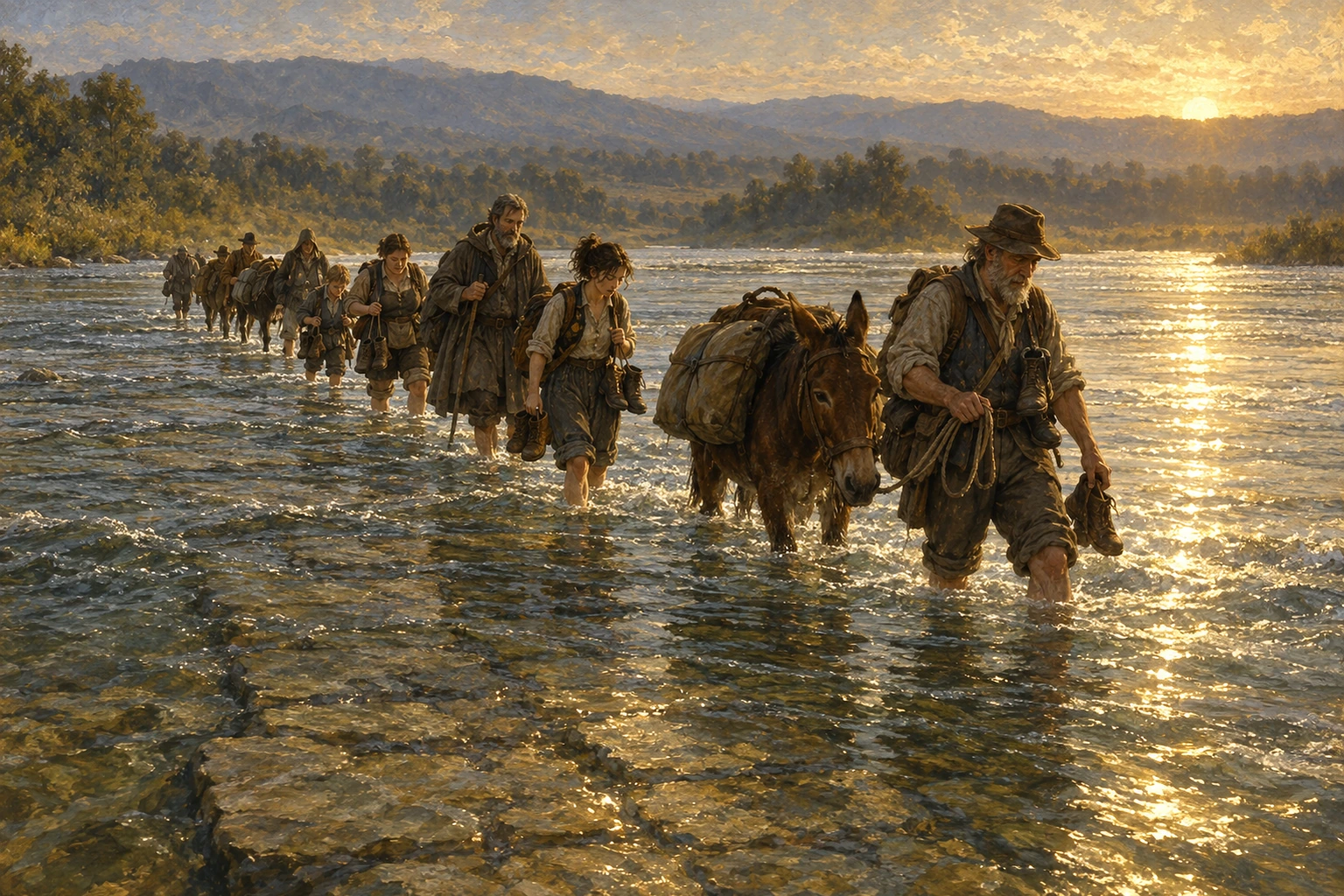
It was low — that was the first thing, low and broad and utterly unlike the elegant three-arched thing drowning downstream. It was a wide causeway of enormous fitted stones running arrow-straight across the whole breadth of the valley, its parapets worn to stumps or gone entirely. Its deck stood not proud of the water as a bridge properly ought to, but a bare hand's width beneath the surface at its highest point, so that the river ran over it in a long smooth sheet, silver and unbroken. And yet it did not look drowned so much as simply patient, the way a good stone wall looks patient under snow.
"Oh," said Iyene, very quietly, and was across the last of the slope and down at the water's edge before anyone else had properly stopped walking — her glass up, her pocket-book already out. She moved along the bank with the fast, absorbed attention Wren had seen in her only once before, over the Waybook itself in the College map-room. "Look at the coursing on that pier — that's stone cut to outlast the mason's own grandchildren, and the mason knew it when he cut it. Nobody builds like that anymore, since nobody plans past their own lifetime if they can help it. Three arches wide at least, under all that water, maybe four — I'll want soundings before I'll swear to the count, but I'll wager my own good glass it's the elder work by two centuries, built by people who built to outlast their own grandchildren's grandchildren, and got, near enough, what they built for." She looked back once at Wren, nothing in her face now but plain professional delight. "Your book found us a better bridge than the one that outlived it. That is not a small thing, Wren Fallowmere."
Bracken, meanwhile, had already waded a careful step into the shallows at the near end, testing the footing with a long pole cut from a fallen branch. He sounded it as he had sounded two fords already since the West Gate — methodical, careful, entirely without drama, moving the pole ahead of each step and trusting nothing his own eyes told him until the pole had told him first.
"Solid," he said, after a long working minute of it, straightening with the particular satisfaction of a man whose caution has been rewarded rather than wasted. "Solid the whole width I can reach, and level, near enough — a foot of good clean water over honest stone, no give in it anywhere I've tried it. I'll take Suet across on the lead before anyone else sets a boot on it, because a mule won't lie to you about footing the way a man's own hope will."
Suet crossed without the smallest objection, placing each broad hoof with the unbothered confidence of an animal who had never in his life seen much profit in making a fuss about anything. He stood on the far bank afterward with an expression of mild, settled boredom that Bracken pronounced, with real feeling, "the best word any beast has put in for a bridge in thirty years of my asking them."
The crossing itself took the better part of an hour, and it was one of the most purely satisfying hours she had spent since leaving Dall — not because it was dramatic, for it was not. It was difficult in the way careful work is difficult: a great many small things, each one done properly, adding up at the end to something that felt, in the doing, almost like ease.
They crossed in order, mules first and lightest-loaded, Bracken leading each on a short rein, testing from habit rather than doubt; then Gable, dozing his way over as though the whole enterprise bored him thoroughly, which by his own long-settled opinion of the world it probably did; then Nettle, who took some persuading at the water's edge and gave it up entirely once persuaded. The company waded after, boots and stockings slung round their necks, trousers rolled, the water running cold and clean and no higher than mid-shin the whole careful way across. Everyone's eyes stayed on the stone underfoot, and everyone's hands, without anyone quite arranging it, stayed near enough to a neighbor's shoulder to catch a stumble that never, in the end, came.
Barrow went last, as everyone had privately expected he would need to. Bracken took him by the headstall himself rather than trusting the lead, murmuring the same low endless string of nothing-in-particular he had used on the drummed planks of the bridge a week and more back. Barrow, dun ears back, nostrils working, took his first step onto the old stone bracing for the worst the world had ever asked of him — and then simply crossed, quiet, level, steady, all the way to the far bank, without once laying his ears flat. Bracken, standing at the end of it with the lead slack in his hand, looked almost as surprised as the mule ought by rights to have looked and hadn't.
"Now then," Bracken said, to Barrow, to the company, to the river in general. "There's a thing." He ran a broad hand down the mule's neck, considering. "It's the drum he can't abide — the hollow sound of his own feet telling him the ground under him isn't ground at all. This isn't planking. This is stone, same as any honest hillside, only wetter, and it doesn't sound like anything false underfoot because it isn't." He shook his head, with the particular respect of a man revising a settled opinion in real time. "I've called this animal a fool over bridges for six years, and it turns out he's had the rights of it all along, and simply never had a bridge honest enough to prove it to me before today."
"His finest hour," Dorrit said, with real admiration, wringing out the hem of her skirt.
"Don't," Bracken said, "tell him that. There's one member of this company already insufferable about a fire well kept, and I won't have a mule getting notions besides."
They made camp early, on the far bank, in the last good hour of daylight, with the crossed river running quiet and silver behind them and the old bridge lying just beneath its surface like a thing sleeping rather than drowned. It was there, with the fire built and Bracken's stew going and boots drying in a companionable row along a fallen log, that Iyene unrolled the Survey's fresh working sheet across the flattest stone she could find, weighted its corners with four smooth pebbles gathered for the purpose, and looked up at Wren.
"Come here," she said, "and bring the book, and bring your own as well. I want this crossing entered before the light goes, while the coursing's fresh in my eye and the count of arches is still an honest guess rather than a memory of a guess." She made room at the stone without ceremony, shifting the pebbles and her own knees over. The rest of the company, without quite being asked to, drew in a little closer round the fire to watch — not crowding, only present, the way a household gathers without comment when something worth seeing is about to happen in the kitchen.
"You'll draw it," Iyene said. "Not I. The line, the pier-count, the water's height against the parapet stumps — I'll check your figures against mine before either of us is satisfied, and we will very likely argue about the exact angle of that eastern pier, out of respect for the work. But the mark goes down in your hand, because you found the crossing, on the strength of a keeper's craft the College charter doesn't so much as claim to teach, and a Survey that let that go unrecorded because the finder happened to be young would not deserve the name it's chartered under." She held out her own pen, worn smooth at the grip by eleven years of use. "Draw it, Wren Fallowmere. I'll enter it after you, on the authority of the Survey, and it will stand in the College's own chests a hundred years from now exactly as you set it down tonight."
Wren took the pen.
She drew the river first, the long slow curve of it as she had walked its bank an hour before. Then the old bridge itself, low and true beneath the water-line she marked with a fine broken stroke Iyene showed her in a breath — the College's own convention for a thing submerged but sound. Then, a little apart, small and plain, the crossed-stroke well and the ragged double line of the verge-oaks that had led them to it, because a road found once by its own ghosts deserved to have its ghosts written down alongside it for whoever needed finding it next. Her hand did not shake, though she had half expected it would. It moved with the quiet certainty of a thing being done because it was true and wanted doing properly. When she lifted the pen at last, the ink stood dark and clean and entirely ordinary on the sheet, no different from any other line the Survey had ever drawn, which was exactly the point of the whole evening.
"There," Iyene said, and took the pen back, and beneath Wren's line wrote a short line of her own in a smaller, harder hand — a date, a bearing, and the plain words entered by W. Fallowmere, keeper, on report; confirmed I. Sath, Cartographer-Royal — and sat back on her heels, satisfied, and looked round the fire. "It wants a name. The College never had one for it, since the College never knew it was there to name, and I'll not put an empty space on a map when six people and four mules have just gone to the trouble of proving there's something worth naming in it."
There was a small companionable silence, the kind that gathers naturally round a fire when everyone privately has a name in mind and nobody wants to be the one to say it first.
"The Drowned Bridge," Dorrit said, at last, flatly, as if she were naming a jar of preserves rather than a piece of history. "It's what it is. No sense dressing it finer than the truth, and the truth of it's a good plain name, the kind that tells a stranger exactly what they're walking into before they get their boots wet finding out the hard way."
Iyene wrote it so, small and neat above the water-line, the Drowned Bridge, and closed the pocket-book on the whole day's work with the same short satisfied nod she gave everything that had, at last, been properly finished.
Alder had not said a word through the whole of it. He sat a little back from the fire's ring, as was his habit, his stick across his knees. Wren, glancing up once from the sheet, caught him watching — not the map, not Iyene's hand moving over it, but her own face — with an expression so quiet she might have missed it altogether if she had not, by now, learned to know the look for what it was. When their eyes met, he only inclined his head, the smallest fraction, and looked back at the fire.
It was not magic, Wren thought later, sitting a little apart with the Waybook warm in her lap while the others settled for the night — she was careful of the thought, as she was of any thought that wanted to run further than the plain truth of a thing would carry it. A road, Alder had told her once, was a kind of memory that outlived the people who walked it. A book, she thought, with the pen's ink not yet dry on a page that now had her own name under it, could be exactly the same kind of thing, if someone loved it enough, and someone else was willing to carry it.