The Wake of Stars
Wren was resetting the string on her bow, working the new cord through the nock a half-turn at a time the way Bracken had taught her early on the road, when Ferrit came up the slope at a run with his coat still half-fastened and no breath left to explain himself properly.
"Dust," he said, when he'd gotten enough air back to manage the one word. "On the low road, past the second bend. A lot of it."
Bracken was on his feet before Ferrit finished the sentence, already turning toward the rise that gave the best look at the valley below the city, and the whole camp came up around him the way it now did at any word that might mean either rescue or ruin, because after three years of road there was no longer any way to tell the two apart from a distance. Wren left the bow half-strung and went with him, and felt, without turning to check it, the particular half-pace of extra distance Bracken had kept between the two of them since the night in the sleeping streets — closer now than it had been the week before, but not yet closed, and neither of them had said one word about it in either direction.
Pip came as far as the tent-line and no further, Dorrit's hand light on his shoulder rather than holding him back outright, and nobody asked him to explain why a boy who drew every stone in this city from memory suddenly wanted no part of standing on a rise to watch a road. His hand found the strap of his sketch-case and did not let go of it.
From the rise, the dust was a long pale smear low along the river road, too broad and too slow to be anything but people — a great many people, walking, with wagons somewhere in the body of it slowing the whole column to a foot-pace that would take the rest of the day to close the last few miles. Alder came up last, leaning harder on his stick than he had a year ago and saying nothing about it, and stood a long moment reading the line of it the way he read everything that might matter.
"That's the west," he said finally. "That's Iyene's muster, or the start of it."
"They'll want the ford," Bracken said. "There's no other crossing this side of the lake, not for wagons." He was already running the arithmetic Wren had watched him run a hundred times on a hundred roads — how far, how fast, what stood between here and there — and the answer came back the same as it always did when the answer mattered. "We go down and meet them at the water. Faster we're there, faster it's done."
Doran's four went as a matter of course, the way they had gone every dangerous mile since the Long Eaves, and no one discussed it because no one needed to. Sael was already checking the fiddle's case-strap against her back out of old habit rather than any expectation of playing it that day. Wend stood a half-step ahead of everyone else, the way he generally did now, as though standing still cost him something the others didn't have to pay. Ossen said nothing at all, which from Ossen meant nothing more than that he was ready. Ferrit fell in beside Sael without being asked, the way he had fallen in beside her at the eaves and every mile since.
"Pip stays," Alder said, once, and that was the whole of the argument. Pip did not fight him on it, which told Wren more than an argument would have.
The walk down was quick and mostly silent, the whole party moving at the pace Bracken set without anyone needing to be told to match it, down through streets the company had walked and warded and half come to think of as their own despite the three centuries of silence still sitting in every doorway they passed, and out through the old south gate onto the open river road with the whole width of the valley opening up in front of them, meadow and gravel and the low glint of water still a mile off. Wren walked near the middle of the column, the Waybook riding against her side the way it always did, and thought, without meaning to, of how many roads this same company had walked down into trouble without knowing, until it was already too late to turn back, what the day actually meant to ask of them.
The ford lay a mile below the city where the river widened and slowed over a long gravel bar, shallow enough at that season to cross on foot with the water no higher than a man's knee at the deepest channel, and the far bank rose gently into open meadow where the west road came down out of low hills before it ever reached the water at all. It was, by any ordinary reckoning, an easy crossing — which was exactly the kind of ground the company had learned, over three years, to trust least.
"Bad ground," Luel said, the moment her feet touched the near bank, in the flat voice she used for facts rather than opinions. "Not deep. But old, and it remembers being crossed a great many times by people who never came back this way to be counted."
Alder's stick found the ground twice before he answered, testing something Wren couldn't see, and then a third time, slower, along the near edge of the gravel bar where the current ran fastest. He drove three lines into the bank the way she had watched him drive a hundred lines before — not a wall, never a wall, but a boundary that told anything crossing it exactly what it had just entered. It would hold the bar. It would do nothing at all for the water itself. "Ward the bar itself," he said. "We can't ward the whole river." He looked to the four Amarin, and something passed between him and Doran's daughter that Wren couldn't fully read. "Can you hold the crossing itself, once they're in the water? A working party can't fight and wade both."
"We were crossing water before this country had a name for it," Sael said, which was not quite a yes and was taken as one anyway.
They took the gravel bar between them, the four of them spread along its length at intervals Ossen paced out without being told to, settling into position with no more ceremony than four people taking up four ordinary jobs — this was the shape the day had always been going to take: the west would cross where the ground let them cross, and somebody would have to stand on that ground while they did it.
The column came into sight properly an hour on, cresting the low hills on the far side in a mass that took the better part of twenty minutes just to finish arriving at the water's edge. Foot-worn people walked it in traveling boots gone through at the sole. Wagons came behind them, drawn by mules as tired as any Wren had ever seen, and here and there a knot of harder faces carried iron that had plainly come recently out of a forge rather than a farm. Ashcroft's feet, by the plain look of the walking — a whole province's worth of people who had never in their lives expected to march anywhere, doing it anyway because the alternative had stopped being a choice some weeks back. Stanhope's iron, unmistakable even at that distance, dark-tempered and unornamented the way underground smiths made a blade when they never expected anyone to admire it, carried by people whose faces had the particular pallor of a folk who had spent a hard winter under a hill and come up into weather they weren't built for. And somewhere in the column's own spine, riders coming and going along its length in the pattern of a relay keeping a line alive, which could only be Sereth's people keeping the whole slow mass from unraveling into a hundred separate roads.
The first faded came up out of the reeds on the near bank before the column's vanguard had gotten a boot wet, which told Wren, in the single cold second it took to understand what she was looking at, that the thing had been waiting in that ground for longer than anyone crossing it that day could have known to fear. It wore what might once have been a farmer's coat, gone the color of the reeds themselves after however many years of standing among them, and it moved the way all of them moved once whatever had been holding a person together finally let go of the last of it — quick when it needed to be quick, and otherwise not caring at all how it stood or how long it waited.
Ferrit was nearest. He put himself between it and the first wading figures without a word to anyone, the way a man moves who has already decided, sometime before this exact moment, what he is for — and the thing took him low, at the knee, dragging him half into the reeds before Ossen's blade found it and ended whatever argument it had been having with the water.
Ferrit did not get up. There was no long minute of it, no last word carried back across the bar to anyone who might have wanted one. He had simply been standing there, and then the reeds closed over where he had been. He was the one, Wren remembered without meaning to in that same instant, who had gone because Sael was going, and had never pretended to any better reason than that, and the reason had turned out to be enough to carry him this far and no further. Ossen stood above him for exactly as long as it took to be sure and not one heartbeat longer, because the column was still coming and the water still wanted holding.
"Ferrit," Sael said, once, flat, from twenty feet down the bar, and did not stop what her hands were doing while she said it.
Wren felt it the way she had learned, across three years, to feel every death that happened near enough to reach — a name going out of the world at an angle nobody had chosen, cold arriving somewhere behind her own ribs that had nothing to do with the river's temperature. She was already moving, Bracken a half-step ahead of her and Dorrit coming up the bar's far end with her staff already swinging, and the two of them together put down what had killed him before it could reach anyone still in the water. It did not bring Ferrit back. Nothing in her whole craft, gentle or otherwise, reached backward across an ending that had already happened; a name a faded's hand had taken was past saving from the instant of the blow, and all her keeping was good for now was making certain nothing else went the same way in the next five minutes.
Two more came up the same stretch of reeds within the quarter-hour, drawn by the water's own churn and the smell of that much living blood in one place, and Wren ended both of them the plain way, hand and name and fold, the way she had learned to do it fast when fast was the only version that mattered: a name found and spoken and taken up whole, cold running up her own arm and gone again before it could settle anywhere. Neither cost her anything she felt in the moment. Whatever either one had taken, it had taken it from somebody standing near her rather than from her — that was simply how the craft worked when it was spent this fast, and she had long since stopped expecting the bill to find its way to her own door.
The crossing did not stop. It could not: three hundred people and more stood strung out along the far bank with nowhere else to cross, and the only mercy available to any of them was speed. Bracken took the water himself then, wading out to the first wagon and putting his shoulder under its axle where a wheel had found a soft patch of gravel, hauling it through by main strength while its driver — a broad Stanhope woman with an underground pallor no season of walking had yet burned off her — called the mules on in a voice gone hoarse from a hundred miles of doing exactly that.
Dorrit worked the near bank the whole crossing through, staff in one hand and the other free for whatever needed catching — a child handed across the last stretch of current, an old woman's elbow steadied against a stone she hadn't seen, a Stanhope man's knee that buckled under him the instant his boots found dry ground and needed setting before he tried to stand on it again. She put the staff to real use only twice, both times against things that came up out of the water rather than things that walked in on two legs already dead, and both times the fight was over before anyone standing near her had finished understanding it had started. No one thanked her for either one. There was always a wagon behind the last thing, and a child behind the wagon, and no proper stopping point in a day built entirely out of the next necessary thing.
The crossing did not pause for Ferrit any more than it had paused for anything else that day. Wagons kept coming down into the water on the far bank at the same steady pace Bracken had set for them, and behind the first rank of arriving people a second rank was already committing to the ford, unaware that the ground under their own boots had cost anyone anything yet.
Ossen held the bar's northern reach alone for the better part of ten minutes when a second faded came at the crossing from upstream, wading it low and fast the way a snake takes water, and he took it in the shallows with an economy of motion Wren had never seen from him before and would not see from him again: three strokes, no more, and the thing went down and stayed down in water too shallow to hide what it had become. He straightened, breathing hard, and looked once toward Sael and Wend, and Wren understood, watching him, that some private accounting had just settled itself in him, the sum of it his alone to know.
He did not get the chance to tell it. The third faded came at him from behind, out of ground already crossed and already trusted, in the one direction the whole bar had stopped watching because the water itself had seemed to promise nothing came from there twice. Ossen went down without a sound Wren could hear over the river's own noise, and by the time Wend reached him — closing the distance in four strides, his own blade already up — there was nothing left to do but end the thing that had done it and stand a moment over ground that had, an hour before, belonged to a man who said nothing all evening and volunteered last and meant every part of it.
Wend did not stand there long. A knot of Ashcroft's own — an old man, two children, a woman with an infant bound tight against her chest — had stalled mid-channel where the current ran fastest. The old man's legs were no longer equal to the crossing, not after however many hundred miles had brought him to this last hundred yards of it. Wend went to them the way he had gone to everything since the Long Eaves: decided before anyone asked him, restless in exactly the way that made him first into the water and first into the reach of whatever the water still held.
He got the old man's arm across his shoulders and the woman's elbow steadied in his free hand and had them three strides from the bank when the water beside him went suddenly, terribly still in the particular way Wren had learned, across three years of bad crossings, to fear more than any splash — and something beneath the surface took him by the ankle and pulled.
He did not let go of the old man. That was the whole of it, the entire shape of what Wend did in the last four seconds anyone had to watch him do anything. He threw the old man the last three strides toward Dorrit's outstretched staff. He threw the woman half a breath behind him. Only then did he go under, and by the time Bracken reached the place he'd gone down there was nothing in the water but current and gravel and the fiddle-strap Sael had lent him a mile back for the crossing, floating loose and already three yards downstream. Nobody found more of him than that. The old man lived, and stood dripping on the near bank with the woman and her infant safe beside him, not knowing the name of the boy who had carried him the last three strides.
Wren did not go still, this time, thirty feet off with the means to reach him and the distance to cross. She was in the water before she had finished understanding what she'd seen, and found nothing to save when she got there — no name coming loose that a keeping could catch hold of, only water closing over ground the way it had already closed once that hour, because ending was the only craft left for a thing already finished, and there was nothing left to end.
Sael was the last of the four standing, and she held the bar's center reach alone through the crossing's worst ten minutes, the water rising past her knees as something upstream shifted the channel's whole flow against her, working three separate lines of rope-guide with a fiddler's quick hands that had spent more winters learning a narrow-waisted neck of wood than they had ever spent on rope. She did not look toward where Ferrit had gone, or where Ossen had gone, or the last of the current still settling over the place Wend had gone under. She held the line, and called the crossing's pace to the column in a voice that carried the whole width of the ford, and got the last forty of them across dry-footed on a rope she alone was keeping taut.
She was nineteen, by her own father's count, in a family that had gone on measuring a woman grown by a reckoning three hundred years out of date, and there was nothing in the whole of that short life that had prepared her for this reach of river any better than it had prepared any of the others. It did not show. Her voice never wavered off the count she was calling, right up to the last full breath she had to call it with.
The fourth faded came for her out of the deepest channel, where the water ran too fast and too dark for anyone to have seen it coming, and took the rope from her hands the same instant it took her — one motion, no interval Wren's eye could separate into a before and an after. Bracken was already moving. He did not reach her in time to matter to Sael. He reached her in time to end what had taken her, in the water, in under two strokes, and to pull what the river had left of the rope-guide back taut in his own two hands before the whole crossing behind it could come apart.
Luel had not moved from the near bank through any of it. She stood at the water's edge with both hands loose at her sides, watching her own kin go into that river one at a time with a stillness that had nothing of shock in it and everything of a woman keeping count — the same woman who had stood at the Long Eaves and told four people exactly what leaving would cost, from the one mouth in that whole household with the standing to say it, and had watched them go anyway, because a warning is not a wall and she had never pretended it was. She did not say it now. She did not need to. When Bracken straightened over what the water had given back of Sael, Luel walked into the ford herself, past the last of the crossing column still hurrying for the near bank, and stood over the same water a long moment. Then she said one word — not the fiddler's name, not a lament, a single old syllable Wren had never heard her use — and the surface of the deep channel went, for the length of one held breath, entirely and unnaturally still, the way standing water goes still before a frost sets into it for good. Nothing came up out of it again that day. Luel turned, walked back to the bank, and picked up the coil of spare rope Sael had left lying in the reeds, and began, without a word to anyone, coiling it properly, the way it wanted coiling, because the crossing was not yet finished and a rope left wrong underfoot was still a rope somebody would trip on before nightfall.
The last of the column came across in the hour after, foot-sore and wordless, and no one who reached the near bank asked what had stood in that water on their behalf; word of it moved through the crossing on its own, the way word does, from the mouths of the ones who had watched to the ones who hadn't, until every soul on that bank knew four names they had never met and would not have known to thank.
The far bank emptied by degrees into a working camp rather than a crowd, wagons peeling off toward whatever ground a dozen quick voices were already assigning them, mules led to water in strings of four, and the whole enormous tired mass of it sorting itself into order faster than Wren would have thought three hundred exhausted people capable of managing on their own. It was not managing on its own. Somebody was standing at the center of it directing every part of that sorting at once, in a voice too flat to carry drama and too certain to be ignored, and Wren found her before she had finished looking.
Wren found Iyene near the wagons on the far side of the settling crowd, directing two Stanhope men toward a stretch of dry ground with three fingers and a flat, unraised word that carried further than shouting would have, and stopped a pace off rather than closing the distance the rest of the way. She was thinner than the road had left any of the company, and dressed for weather rather than survey work, a canvas coat gone shapeless at the shoulders where a theodolite's strap had once ridden and now rode nothing at all. Iyene's weight came down wrong on the left side with every second stride, a permanent list she made no attempt to disguise and no one standing near her seemed to find worth remarking on twice, and she crossed the last stretch of ground to the wagon line the same way regardless, faster than the limp alone should have allowed.
"You're standing," Wren said.
"I'm standing." Iyene's eyes went once, briefly, to the water behind her, and back. "You're taller."
"You're late."
"I'm here." She turned back to the wagons before either of them could make it more than that, calling a number and a destination to a Stanhope man already moving to obey it, and the whole of what had passed between them was done in under forty words and neither one mentioned a letter that both of them plainly still carried somewhere they weren't showing.
She was already three sentences into her next problem before Wren had finished stepping back to let her work. Which of the Ashcroft wagons carried grain fit for immediate distribution and which needed sorting first. How many of the Stanhope iron could stand a watch tonight against how many needed a full night's sleep before they were worth posting anywhere. Where in a city the size of Cael Meddan three hundred exhausted strangers could be housed without putting a single one of them within reach of ground the company had not yet walked and cleared. She gave each answer the instant the question finished forming, in the flat certain register of someone who had worked it out somewhere on the road several days back and had simply been waiting for the ground to catch up to it.
Pip came down from the tent-line once the crossing had gone quiet, walking the last stretch of ground with Dorrit a half-pace behind him rather than beside him, and stopped well short of the water itself. He looked a long while at the four places along the bar where the fighting had settled, not asking what had happened at any of them, and Bracken, passing him with an armful of wet rope, said only, "Amarin. All four," in a voice that offered nothing further and expected nothing further asked. Pip nodded once and did not go any closer to the water than that.
By evening the count of what the west had lost on its own road came down through Bracken from a Stanhope captain built like a doorframe, given the same flat way any tally was given at the end of a hard day. A boy of fourteen, coughing since the second pass, dead of it a week back and buried in ground they'd had no time to mark. Two mules foundered and left. A Sereth rider thrown from her horse on a bad night crossing and not yet walking right, carried the last three days on a cart meant for grain. Nobody called it a small cost. No one called it anything at all, past the plain count of it — a country that had just walked itself half to pieces to reach a war did not need anyone standing over the wagons explaining what the walking had cost.
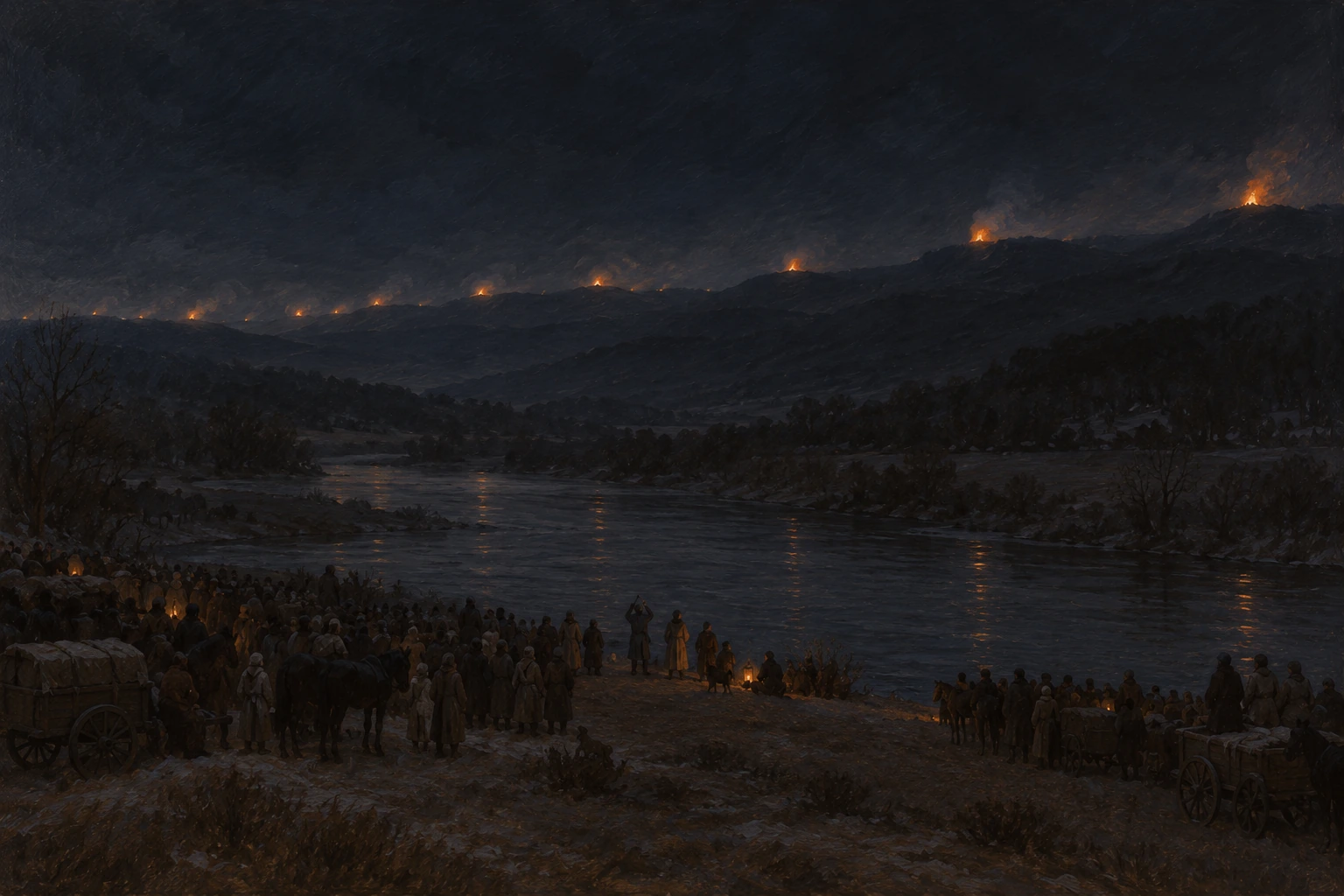
It was full dark before anyone thought to look east, and it was one of the Stanhope iron who saw it first and said nothing, only stood and pointed, because there are things a country waits three hundred years to see and does not trust its own voice to announce.
The line ran the whole visible length of the horizon. Kelder stood high and steady, where it had stood dark the better part of a season since Wren herself had watched it lit. Wakelow burned as it always had. A dozen hills between them Wren had no names for, each one answering the next in a long chain of small hard lights, ran all the way east to a low glow on the furthest edge of seeing that could only be the basket above the Watch itself, burning at the corridor's own foot. Every fire on it was lit. Nobody living had ever seen that sentence be true.
Word of the line had not yet reached the near bank in any form anyone could have named, and would not for a long while — the Stair stood shut behind it and nothing had crossed since autumn, so not one soul standing in that firelight had the smallest notion what the lit line had cost to keep burning at its eastern end, or who had spent the worst of that winter's price. They saw only the fires. That was enough, that night, to stop three hundred tired people where they stood.
Someone in the crowd began to sing before Wren had finished understanding what she was looking at — an older Ashcroft woman, by the sound of her, low and even, the words coming up out of some deep unbothered place that had carried them across three hundred years without ever expecting to need them sung this way:
Forty fires stood the line from the Stair down to the sea. Every one a promise kept by hands too far to see. Watch, said the first. And watch, said the next. And watch the whole night through. But who was left to watch for us when the dark came watching too?
Others took it up within the verse's own turning, catching from one voice to the next the way flame catches dry grass, until half the crossing was singing it, west and company both, voices that had never stood in the same country together an hour before now carrying the same old tune across a river that had taken four of them that same afternoon:
The first went dark on a night of frost. No one saw it go. The second followed a season on. The third, the following snow. Kelder held the longest of the line, dark three hundred years and more. No one living remembered the fire that used to stand at that door.
Wren did not sing. She stood with Bracken's shoulder a hand's width from her own — closer than the cold alone required, and neither of them remarked on it — and watched the line burn the whole width of the world, and thought of four names the song did not know to hold and never would. The verse did not change to fit the night. It ran the way it had always run, every hill going dark in its old order, grief laid down exactly as grief had first laid it down three centuries before anyone standing on that riverbank had been born to feel it fresh.
More voices found it with every line, the way flame finds every dry thing in a room it has been given time enough to reach, until Ashcroft and Stanhope and Sereth and the company itself were carrying the same eight bars together without one of them having taught it to the others:
One by one the watchers slept at their posts, and no one woke them. Forty fires, and forty names, and only the wind that spoke them. Ness Fell went dark, and no one marked it. Wakelow alone stayed lit — one candle in a country's window, burning on for nothing but the keeping of it.
Forty fires, and not one lit. Not one, from the sea to the Stair. So sing them dark. And sing them lost. And sing the empty air.
They sang it dark, the old words doing exactly what they had always done, and the line stood lit behind every voice that sang them, from Kelder to the low east glow that was the Watch's own basket burning at the foot of a pass nobody on that riverbank yet knew had cost it a captain. The song did not know that either. It went on being a lament, faithfully, to the last word — and every soul on that bank, west and company together, heard it as the other thing entirely, because for the first time in three hundred years the country the song mourned was not, in that hour, dark at all.
Luel came to stand at the edge of the singing rather than inside it, the coiled rope still over one shoulder, and did not join her voice to the rest of it. Wren did not press her on it.
Iyene stood a little apart too, on her uneven feet, reading the fire-line the way she had once read a survey sheet, already turning some private arithmetic of roads and distances that the light of it would now let her finish — how far a wagon-train could move by that light instead of by guess, how many days it would save the column behind this one, what a country could do now that it could see the whole shape of its own war laid out hill by hill instead of piece by piece in whatever letters happened to survive the road. She did not say any of it aloud. There would be time for the saying of it in the morning, and the fire-line would still be there to argue from.
Wren stood between the two of them and neither one, watching a line of fire her own hands had helped set burning at Kelder answer, hill by hill, all the way to a foot of mountain she had never walked and now never would, and let the old song go on being about the dark, because that was the only way anyone standing on that riverbank had ever learned to sing about the light.