The Smoke Answered
They walked twelve days out from Aldern, and every one of them, in ways too small to point to singly and too many by the end to disbelieve, told the company the same patient thing before any of them agreed to say it aloud.
The first was only another sleeping village, smaller than Aldern and further gone to green, its streets given over to grass — but its well showed the same clean-swept coping as the well inside Aldern's mended gate, moss scraped back to bare stone within the year. The second was a bridge where one rail out of a dozen stood newer than its fellows, pale wood pegged in among grey with a carpenter's patient care. The third was a culvert cleared of a hard winter's silt recently enough that the freed water still ran a shade quicker than the moss on either bank had caught up to noticing. And on the fourth day, cresting a shoulder above a vale gone to old orchard, Dorrit stopped at a row of trees pruned clean exactly as far as the road's edge and not one tree beyond it, the wild growth resuming as sharply as if a line had been ruled across the ground.
"That's not weather did that," she said, turning slowly to take the vale in, "and it isn't three hundred years of nobody, either. Somebody comes out this far to prune, and no farther."
Bracken stood beside her a while, reading the vale with a working eye. "A day's walk," he said at last. "Whoever tends this ground tends it out to about a day's walk from wherever they're keeping, and no farther, because a day's walk is as far as a body can go and still be home by dark to see to the fire." He said it plainly, a fact for the ledger, though something in his voice was working rather harder than it let on to sound so plain.
Arguing it would have meant saying aloud what the whole company had carried, carefully unspoken, since Aldern's gate — that the smoke from the saddle was drawing nearer now by more than distance, and that the tending they kept meeting was not scattered evidence of many hands but the visible edge of one hand's daily round.
It was Iyene, on the eighth day, ruling a fresh line onto the working sheet, who turned the thought around to look at its other side.
"I have been thinking about smoke," she said. "Not ours, this time. Ours." She set the pen down. "We have had a fire every night since Aldern, same as every night since Merrow, standing up into this same sky, thin and steady, the way that first thread stood up for us at the saddle. If somebody out there has watched a smoke draw nearer, evening on evening, with no Waybook to tell them what it meant —" She let the rest arrive on its own. "We have been somebody's smoke. This whole time."
Bracken went on shortening a strap he had already shortened. It was Alder who nodded, slowly, at a thing he had already half known and was glad, all the same, to hear said.
"Two smokes," he said, "watching each other come."
They walked the rest of that day, and the days after, a little differently for having heard it said — not faster, but with a settled attentiveness, as though each of them had begun composing, without discussing it, the face they meant to wear when whatever waited at the far end of all that tending finally stood in front of them.
The last of the twelve days brought the road down out of open hill-country into a fold of the valley so gentle that Wren did not, at first, understand she was descending at all — only that the light had gone long and gold, and that the grass had thickened from wild pasture into something with the orderly generosity of a hayfield mown on purpose and left to grow back kindly.
It was Pip, glass out of habit rather than need, who called back first, his voice climbing with an excitement he did not trouble to flatten. "Smoke. Straight up — no wind to bend it — and it's close."
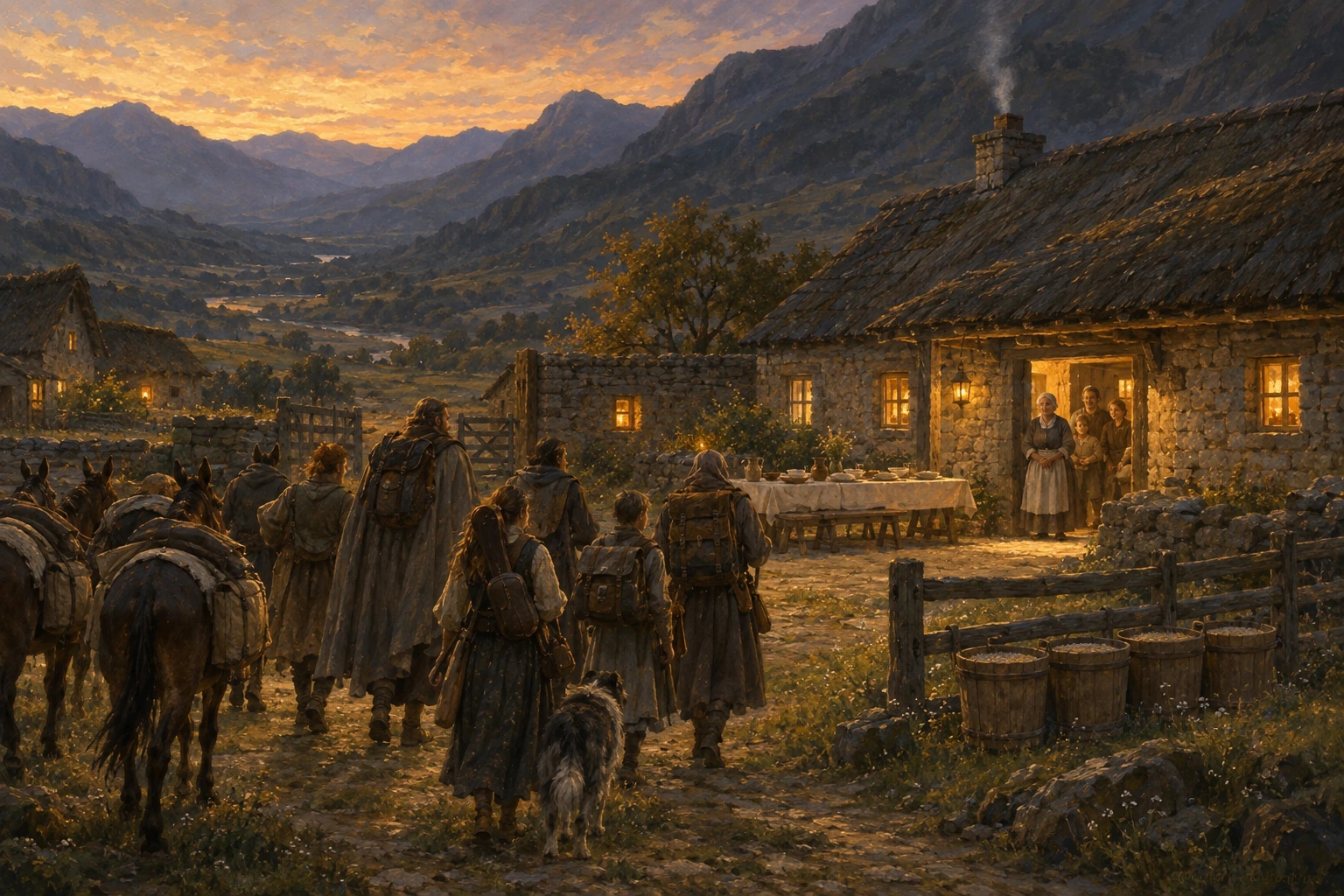
They crested the last rise together, none of them willing to be first and look alone, and the valley opened below all at once: a steading held close between two gentle shoulders of hill, the way a hand is held close around something it means to keep warm. Fenced paddocks with real stock grazing across them; a kitchen garden laid in rows too straight and too generous to be anything but generations deep; a byre with lamplight already glowing gold within it; hens crossing the yard in their busy, indignant way; and at the steading's heart a long low way-house, turf-roofed, its chimney breathing the one thin, patient, windless thread the company had carried in their eyes the whole length of the west.
The door stood open, as every way-house door on the road had stood open. Every window burned with lamplight, though the sun had not yet properly gone.
And the table was laid — a long trestle under the low eave, cloth and plates and cups set out in a neat row, for seven. Along the paddock rail, four buckets stood ready, grain measured into each, waiting on four animals none of the household could yet have seen with anything but a glass and a very great deal of hope.
Wren felt the whole company go quiet at once, and felt Dorrit's hand find her own without either of them deciding it, and hold there.
They came down into the yard at a slow, deliberate pace, Bracken alone matching his stride to the mules' — and there, in the doorway, stood a woman with her hands folded in her apron, and behind her, holding themselves still by main force of will, a man, a younger woman, and two children peering round their parents' legs with their eyes gone entirely round.
The woman was small, upright, and dry as good wood is dry — seasoned rather than withered — grey hair pinned back plain, her face plainly having spent the last hour failing to entirely decide what expression it meant to wear. She did not come forward. Later, over the fire, she would tell them why: that meeting them on the road had been discussed and its nerve had failed; that pretending an ordinary evening indoors had been discussed and rejected as its own cowardice; and that the doorway, in the end, was the whole family's compromise — the one place a person could stand neither hiding nor chasing, only ready.
She looked the length of the yard — at seven strangers and four mules, at Bracken's plain coat and Iyene's ruled satchel, at Luel quiet in her shifting grey-brown cloak — and something crossed her face Wren recognized before she understood it: not fear, not disbelief, but a thing hoped for so long and so carefully that the hoping had nearly become its own grief, meeting, all at once, its own fulfillment.
"Who crosses?" she said. Her voice did not shake. It carried the whole yard's silence in it — an old formula said so many generations running it no longer needed weight to carry meaning, only the saying.
Alder stepped forward half a pace, his stick set quiet against the ground. "A charter out of Merrow," he said, "sworn to King Osmund and the College of Roads, seven strong and four beasts besides. Alder, of that College. Iyene Sath, Cartographer-Royal. Bracken Hale, quartermaster. Wren and Dorrit Fallowmere. Pip Sandover. And Luel, of the Amarin, who walks with us by her own choosing and no charter's binding." A small pause. "We come west on the road that was always going this way, and we mean no harm to anything kept here."
The woman's eyes rested longest, if only a moment, on Luel — and something in her whole bearing loosened at once, a held breath let go.
"Then you'll want supper," she said. "It's been kept."
She said it plainly, in the same flat, even tone she had asked her question in — and Wren, standing very still with Dorrit's hand still tight in her own, felt the whole weight of the two words land sideways: kept, meaning warm on the hob and ready; and kept, meaning minded and waited-on since a door was last shut on a guest who never came, and not allowed, in all that keeping, to be forgotten. It was not, quite, a joke, and both sides of the yard left it where it stood.
It was the small things, after that, that let the evening find its feet.
The woman crossed the yard at a short, no-nonsense stride and stopped in front of Bracken — not Alder, not Wren, but Bracken, whose coat carried, stitched small at the shoulder, the little sun-and-road mark every chartered coat in the company wore. She reached out and touched two fingers to the stitching, lightly, once, and left them there a beat before she took them back.
"There," she said, half to herself, drawing her hand back, for one unguarded moment almost undone by the plain fact of thread under her own fingers. "I've heard my mother tell of that mark since I was smaller than my own girl there, and I never believed I'd lay a finger on the actual thing."
"Sewn on by a College tailor in Merrow not two years back," Bracken said, gruff and gentle both. "Ordinary as thread gets."
"Ordinary," she said, something in her mouth not quite a smile. "We'll see about that."
She was Edda Hazel, the household's introductions arriving across a dozen scattered moments rather than any order: her son Garron, broad and quiet, hands loose at his sides in the stillness of a man who lets strangers come to him; his wife Liss, already moving, already counting heads; and two children — a girl of perhaps ten with her mother's quick eyes, and a small boy not yet steady on his feet all day — both staring at the mules with an open wonder that undid something in Wren's chest before either had said a word.
Garron came to Bracken first, at the paddock rail, turning a withy of the fence's own gate over in his hands before he spoke at all.
"You mend a gate with two bindings a season apart," he said. Not quite a question.
Bracken looked at his hands — the calluses, the particular set of a man who reads rope and hide and green wood for a living. "We found one. West edge of a sleeping town, near enough a fortnight back. Good clean work. No hurry in it."
"That'd be mine," Garron said, plainly, without pride or apology. "Two visits. Ran short of light the first time." A pause, the withy still under his thumb. "We closed it behind us both times. Latched it proper."
"You closed it behind you," Bracken said. "We saw."
Garron set the withy back against the post and squared it with his thumb — two working hands recognizing each other's craft before either had troubled to give the other a name, the same grammar, Wren thought, watching it, that old Orran had used on the beacon-basket a lifetime and a mountain range ago.
The children, meanwhile, had found Luel. It happened quietly — Wren looked up to find the small boy already standing in front of her cloak, entirely unafraid, gazing up with the frank delight small children bring to anything wonderful nobody has yet explained to them as dangerous, and the girl a half-step behind, whispering urgently to her mother a word that ended, audibly, in Amarin — said not as a question but as an identification, the way a child names a bird she has been shown in a picture and finally, astonishingly, sees alive.
Luel went very still — not the guarded stillness Wren had learned to read in her at strangers' curious stares in the lowlands, but something older: the stillness of a person receiving a welcome she had not let herself expect, offered so plainly, so young, with no wonder attached to it at all. She crouched to something nearer the boy's own height and said nothing Wren could hear, and the boy laughed and reached out and touched the hem of her cloak with one finger, to prove to himself it was truly there.
"The west remembers you," Edda said, watching this, to no one in particular, "whatever else it's forgotten how to expect."
It was Edda's eyes that found Wren last of all, and rested there a held breath longer than they needed to — and something in the older woman's own bearing, upright and dry and steady, struck Wren with such private, sudden force that she had to look away a moment: it was Granna Tansy's own stance, transplanted whole across three hundred miles and generations of separate keeping. She carried it the rest of the evening as she carried the satchel at her hip, close and against the body.
Supper came as it comes in houses that have spent a long time practicing for a guest who never arrived and have never let the practice go slack: a thick stew, good bread and butter, a crock of something dark Liss called hedge honey, and cider poured without stinting — every dish arriving slightly before anyone had finished the last, so that Liss was on her feet again and again, refilling bowls nobody had emptied, in the busy, displacing way of a woman who has run out of things to say and decided her hands might as well go on being useful.
Dorrit found her within the first two courses, and by the time the bread had gone round twice the two of them were deep in an argument about hedge honey and a slow fire versus a hot one, conducted with the easy intimacy of women who had never met before that hour and had known, within the first exchanged sentence, exactly how to talk to one another. Bracken and Garron, at the table's far end, drifted into the low, half-finished sentences of two men discussing stock — a goat's udder, the cow's temper, a lame ewe Garron meant to look at come morning.
The children had spent the meal's first quarter hour working up courage toward Pip — nearest their own size, and to a ten-year-old's eye the most interesting person present — and ended, by the second course, wedged one on each side of him, the girl asking in a fierce whisper whether he had truly seen the Doors of Cloud, the boy simply leaning his small warm weight against his arm, until Pip sat entirely still, holding his spoon very carefully, with the stunned, grave delight of a young man handed something he does not yet know how to be worthy of.
The talk, through all of it, stayed small — names, the road, the mules and what each answered to, whether the winter would run hard or soft. Nobody asked, and nobody offered, the larger things: not Sereth's whole history, not the lights that had burned twice in the passes, not what waited further west. It was Wren, passing the bread to the girl a second time, who understood that the restraint was not shyness on either side but courtesy practiced twice at once — the same grammar the company had learned from Luel that first autumn fire, a true thing offered once, plainly, and let stand without pressing — now kept, unrehearsed, by two households who had never met before that evening and had arrived, independently, at exactly the same good manners.
Only twice did the evening's smallness give an inch. "Eleven days," Edda said once, ladling stew into a bowl not yet half empty. "We've watched your fire eleven evenings running, off the high shoulder where Garron keeps the goats of an evening. I told myself the first six of them I was only seeing what I wanted to see." She set the ladle down without looking up. "I stopped telling myself that on the seventh."
And later, when Bracken mentioned the gate at Aldern's western edge, Garron only shrugged — an easy, unembarrassed movement — and said, "Well. It wanted doing," as though the whole weight the company had carried that gate under for a fortnight could be answered, honestly and entirely, in four words and a shrug; and, Wren thought, watching him say it, perhaps it could. Neither spill went further. The talk folded itself back into mules and weather and hedge honey, and stayed there.
It was after the plates were cleared, and the children allowed, over Liss's mild protest, to stay up past their hour on the plain grounds that an evening like this one was never coming twice, that Edda rose and went to a low shelf beside the hearth and came back carrying a book.
It was bound in leather gone the soft grey of driftwood, iron-capped at the corners, its pages ruled and, page after page, entirely blank.
"Every way-house keeps one," Edda said, setting it down with the same careful hand Wren had watched Wystan's own book set down a hundred times by her own hands, "or every way-house that means to be one rather than merely a house. Ours has stood on that shelf, dusted every week and the ink kept fresh beside it, since before my grandmother's grandmother could tell you how far back the standing began." She turned, slowly, past page after empty page — a hundred of them, Wren thought, watching them pass, perhaps more. "We don't keep the filled ones here, I hear tell they do down at the border. We've none to keep. We keep the empty one ready instead, and trust the road to fill it in its own good time."
Near the very front, on the one page that was not blank, she set two fingers lightly beside the ink, not on it — a gesture so exactly Wren's own that the small hairs rose along her arms before she understood why.
The hand was faded but legible, a handful of names written close and hurried, the season's weather plainly pressing on them. Beneath, in a different, steadier hand — a keeper's hand, the same careful economy Wren knew from Wystan's own margins and her own grandmother's ledgers both — ran a single closing line:
Closed the book on the year's guests. The house stays. The door stays open. Someone will come.
Wren went very still for a long moment. She felt the words settle into her the way the Drowned Bridge's cold water had settled around her ankles the first time she crossed it — not painful, only entirely, bodily real — she was looking at the last night before the passes shut for three hundred years, written down by a woman who could not have known, and had written anyway, in the flattest and most ordinary hand imaginable, exactly the promise her own family had been keeping, from the other direction, the whole time.
"That was the last hard winter before the long one," Edda said quietly. "She didn't know that when she wrote it. Nobody does, the last time. You only find out afterward that it was the last time." She closed the book gently over the old page, opened it again to the first blank one, set the pen down beside it — worn, well-kept, its nib freshly cut — and looked, for the first time all evening, directly and only at Wren.
"You'll sign first," she said. Not quite a question, though it left room, courteously, for no.
Wren looked down at her own satchel, worn at her hip through the whole meal exactly as it had been worn through every meal for the better part of a year, the strap never slipped from her shoulder even at table — and knew that Edda had marked it hours ago, in the yard, before either of them had said a word, because a keeper carries herself a particular way at every table she ever sits down to, and another keeper, a whole world apart and long out of the habit of expecting company, knows the carrying on sight.
She took up the pen and wrote her own name — Wren Fallowmere — in the first clean line of the first blank page in three hundred years, her hand steadier than she expected, and glad of that steadiness rather than surprised by it.
Dorrit signed after her, with her usual cheerful disregard for the ruled line; then Alder, plain and unhurried; then Iyene, in her full careful style, to Edda's open delight; then Bracken, and Pip with his small pleased flourish, and Luel last of all, who did not sign with letters but drew, beside the blank, one small neat mark of her own — not the curved wing, but something else, simpler — and set the pen down.
Edda watched the pen pass hand to hand down the length of her own table with an expression too large for triumph and too quiet for grief, worn on a face gone otherwise entirely steady — the face, Wren thought, of a woman who has just watched a debt paid that she had long since stopped expecting to see paid in her own lifetime, and does not, now that the waiting is over, quite know what to do with her hands.
The Waybook stayed in the satchel at Wren's hip the whole evening, unopened, unmentioned, its own long history folded quietly away behind the ordinary cloth — too large, Wren thought, for a first table, and rightly so. There would be time enough, some other evening, for the book to meet the book. Tonight wanted only what it had already, entirely, been given.
Beds were made up before the fire had properly burned down — two low rooms off the hall, aired, Liss said, every spring without fail since before her grandmother's grandmother, the linens turned though no one had slept in either room in living memory.
Over the banking of the hearth-fire came the evening's last small comedy. Bracken, out of a year's worth of habit, began, without quite thinking about it, to work out aloud who ought to take the first watch.
"No need," Edda said, mild and immovable as a fence-post. "There's no watch kept under this roof. Never has been, not since before anyone living could tell you why. The house has minded itself this long; I expect it can mind one more night with company in it."
Bracken opened his mouth on a lifetime's professional argument, and Alder, from his chair by the fire, said only, "Let it go, Bracken," without looking up — and Bracken, after a moment's plain and rather comic struggle with himself, let it go, muttering something about soft country making soft habits, and went to bed unwatched for the first time in a year, which he would admit, the following morning, to having slept entirely through.
Luel took the low stool by the hearth instead, in her own fashion, and sat with the banked coals through the small hours, as she sat every night's watch. It was there, past midnight, that Edda found her — coming down out of a long habit of her own to check a fire that had not, in all that time, been left entirely to itself overnight — and stopped in the doorway at the sight of another figure already keeping it, and came no further than the hearth's own edge, and said, after a long moment, only, "Warm enough?"
"Warm enough," Luel said.
Edda settled onto the stool's low twin across the hearth, and the two of them sat a while together, watching the same coals — one keeper of a fire and one keeper of a road, meeting, for the length of one banked night, in the small hours neither had ever expected to share with anyone at all.
Wren wrote by candlelight, later, in the narrow bed made up for her under a roof that had waited so long to hold a guest's weight again, her day-book propped against her knees and the satchel, for once, set down within arm's reach rather than worn.
The smoke has a name now, and a face, and a whole family's worth of hands behind it. It is called Sereth, and it belongs to the Hazels, who have kept it eleven generations, and neither of us knew, until this evening, that the other keeping was still going on. We have been somebody's smoke this whole time.
Edda gave me the pen for no better reason than that a keeper knows a keeper by the satchel that never leaves her shoulder, even at table. I signed my name first, in the first clean line of the first page of their guest-book in longer than anyone at that table had been alive.
Above their hearth, cut plain into the beam the way a family cuts the thing it means never to have to explain twice, runs their own charge, eleven generations old: Feed the fire, keep the door, and believe the road. My own family's has different words and the same shape entirely — keep it against the thaw, and when the road opens, the book goes home — and I sat a long while tonight turning the two of them over together, before I understood they were never two promises at all. They were one promise, kept facing two different directions, by two households who never stopped believing the road would open, and were both, tonight, proved quietly right.
There is no watch set under this roof tonight. The house has minded itself the whole time and Edda would not hear of us minding it a night longer for her. Eleven generations of my family kept a book against this road opening. Eleven generations of theirs kept the door it opens onto. Tonight both keepings slept under one roof, and I do not have anywhere better to be in the whole of the world.
She read the line back once, and did not change it.
Somewhere below her a cow shifted in her stall, and the old wood of the house settled around her exactly as Fallowmere had settled every night of her childhood. She slept in a kept bed, under a kept roof, at the far end of the whole long road, better than she had slept anywhere since Dall.