The Book That Cannot Be Given
The morning after was ordinary, and being ordinary took a good deal of work.
The barley on the two low fields was nearly in, so there was reason enough for everyone at Fallowmere to be about their business early and say little. But Wren noticed, laying the fire, that she had laid it larger than the morning wanted — as if the house meant to keep something warm all day whether it needed it or not. She noticed too that she had gone to the gate to look at the empty road, the way a person checks a latch already known to be fastened.
Granna Tansy came down at her usual hour, neither early nor late, and ate her usual breakfast, and said the usual things about the weather holding, or not holding, which came in the end to the same observation dressed two ways. But she took her chair afterward — the low one by the window that had been, this last week, less a chair for sitting and more a kind of post kept. From it she could see the gate, the first bend of the road, and the chimney of the Bridge Inn where it stood up beyond the willows, small and blue-smoking. She had the honey jars out on the table before her, the crop from yesterday's frames settled and skimmed and ready for the lids. She went along the row with her thumbnail testing each seal, the way she had tested seals for sixty years, finding, as she nearly always did, that they were sound.
"Twenty-two," said Granna Tansy, of the jars, and then, a little later, having gone along the row again for no reason Wren could see except that her hands wanted the doing of it, "twenty-three."
Wren counted them herself, from the doorway, meaning only to be helpful, and got twenty-two the first time and twenty-four the second. She stood there a moment with the number refusing to hold still in her head — which had never happened to her with a row of jars in her life — and said nothing about it, because saying it would have meant saying why.
The book went unmentioned, and Master Alder with it, and the ink that had gone the colour of frost-haze and come back dark in Granna Tansy's own hands, and the sentence that had been passed in that room from mother to child for nine generations together and had never, until yesterday, been said in a stranger's hearing. The clock on the chimney-breast ticked between the shelf and the unsmoked pipe exactly as it always had. The Waybook sat where it always sat: closed, ordinary, a brown leather thing that any stranger glancing in at the window would have taken for an account-book or a ledger of rents, and thought no more of it. That, she thought, was rather the point of where it sat.
She went out to the garden rows after the jars were lidded, meaning to lose an hour in beans, which wanted stringing before they went woody. She found Dorrit there ahead of her, on her knees in the dirt, with a look of ferocious concentration directed at a very small number of codling-moth grubs.
They worked a while side by side without talking.
"I'm not going to ask you," she said, to the beans, not to Wren. "Nobody in this house is going to ask you, which I notice, and which I think is meant kindly, and which I also think is a great deal harder on you than if somebody simply asked. So I'll say the one thing, and then I'll be done, and we'll talk about the moth, because the moth is a genuine problem and you are not, strictly, my business."
Wren went on stringing beans and did not look up, which was answer enough that she was listening.
"Whatever you decide," said Dorrit, "this garden will still be here, and so will I, and so, very likely, will the moth, more's the pity. Now — Ket Sallow swears vinegar-water keeps them off the early pods, and Ket Sallow also swears his middle hive throws twice the honey of the other two, which it does not, so I want your opinion on the vinegar before I trust it to my beans."
And true to her word, that was all she said on the matter; she talked codling-moth and vinegar for the better part of an hour after, and Wren loved her for it.
In the afternoon Wren found reasons.
She told her grandmother she would carry a jar of the new honey down to Hobb, since he always wanted the first of it for his griddle-cakes and would only send the boy up for it otherwise. And she told her that her fiddle wanted new strings besides — the third string gone thin and false since the fair — and Hobb kept a paper of them behind the bar for the players who came through. Both of these things were true. Neither of them was, in the way that mattered, the reason she was going, and she knew it, and did not examine the knowing too closely, the way one does not put a candle too near a thing one would rather not see plainly just yet.
The west road in the last week of the barley harvest was a road doing exactly what it had always done at that time of year. Wren walked it slowly, with the jar wrapped in a cloth against her hip, past the plum-boughs at Widow Callow's still propped on their forked sticks, past the river running low and brown-stoned, past the last of the barley standing gold in Hask Farrow's low field. She knew this road, in every season of it, and had never before had cause to think of it as a thing that might be walked away from.
Master Alder had the good end room at the Bridge Inn, and the door to it stood open to the yard for the sake of the light and the air. So Wren, coming round from the honey delivered and a fresh paper of fiddle-strings bought off Hobb at the bar, found him at his table with his papers spread before him in their neat considering ranks, and his stick — the plain ash stick, worn smooth at the grip — standing upright by the door where he always set it, never carried within.
"Wren Fallowmere," he said, looking up, with the manner of a man glad of whatever the day brought him and unwilling to claim credit for having foreseen it. "Come in, if you've a mind. I've been reading the same paragraph three times over and getting no further with it, so you'd be doing it a kindness to interrupt."
She came in, and sat, when he moved a stack of papers to make room, in the second chair, and took the fiddle from its bag across her knees, glad of something to do with her hands besides sit idle. For a little while neither of them said anything of substance at all. He asked after the honey crop, and she told him twenty-two jars, or twenty-four — she was no longer entirely sure which — and he laughed at that, and went on sorting his own papers while she worked the old string free of its peg. He said he had counted the same milestone four times on the road up from the south and got a different number each time, and put it down to the mind doing arithmetic on something else entirely while it kept the numbers merely as a courtesy.
Then she asked him, because she had come to ask him, and because putting it off further would only have made the asking harder rather than easier, how long the road would take, once walked.
"The better part of two years," he said, plainly, as if she had asked him the time of day. "Three, if the passes prove slow, which by every old account they will. There is a winter to be sat out at the border watch in any case — the Gray Stair stays closed until the spring thaw is well and truly in, whatever the shepherds' green grass may promise us early."
She asked him who went.
"Seven of us, by charter, give or take an apprentice not yet chosen. Cartographer-Royal Iyene Sath leads it — you'll like her, or you'll find her exacting past bearing, and very likely both at once; she is nearly always right, which does not make her easier to argue with. Bracken Hale keeps the stores and the mules, an old soldier of the border watch who trusts a mule's opinion of the weather a good deal further than a man's, and is not, in my experience, wrong to. Myself. And whoever the College sends as apprentice, which I do not yet know, since that seat has stood open rather longer than the others." He said this last with no particular weight on it, and did not need to.
She asked him, then, what she would actually do, out there on such a road, since she was neither cartographer nor soldier nor scholar of any roll or charter.
"Hold the book, and walk," he said. "That is the whole of the office, at the root of it. But there is real work under that, learnable work: how to copy a line fair, so a hand shaking with cold does not put a false kink in a true road; how to take a waymark and hold it against the day's error; how to keep the day's line, a small daily arithmetic that any careful person can learn in a season. The Survey does not need you to be bold, or quick, or anything past what you already are. It needs you present, and it needs the book in a keeper's hand, dark and clear, where any other hand would see it fade to haze. That is not a small thing. But I would be doing you a disservice to dress it as a large one."
She asked him, last of the hard questions, what the danger was.
Below in the taproom somebody laughed too loudly at something, and a chair scraped, and for a moment the ordinary noise of the inn came up through the floorboards and filled the little room before it settled again. Alder waited it out without seeming to notice it at all. Then he was quiet a further moment before he answered her, deciding, as he seemed to decide most things, how to say a true thing without either shrinking it or dressing it in more colour than it owned.
"Weather, first and plainest — height, and cold, and footing gone bad on stone nobody has walked in longer than living memory to learn its temper. A long way from any doctor, the whole of it; that I will not soften. And under all of that," he said, and his voice did not change, though something in the stillness of the room seemed to gather round the words, "the old cold that closed those roads in the first place, which does not come at a person the way a wolf comes, or a river in flood — it comes the way frost comes into a cellar, slow, and it does not want fighting so much as it wants outwaiting, and out-remembering. You do not fight the Quiet with a sword. You fight it by remembering your own name, and your grandmother's kitchen, and the sound of your own bees, on a night when all three seem a very long way off and not perhaps worth the trouble of remembering." He looked at her, quite steadily. "I do not tell you that to frighten you. I tell you because I think you are the sort of person who would rather know the shape of a thing than be handed a comfortable lie about it, and because I have found, over a good many years of walking toward that country, that it is a truer kindness to say so plainly than to promise a safety I cannot in honesty promise."
She sat with that a moment, and found her hands had gone quite still around the fiddle's neck, the peg only half turned — the stillness of someone waiting for a blow they can't yet see coming.
She asked him, at the last, what became of the book if the walk was never made.
Here he did not answer so quickly, and when he did, something in his worn, river-stone voice had gone a little duller, a little more careful.
"It stays what it has always been — a family's book, kept well, kept lovingly, and kept, in the end, for nothing but itself. The College would send someone, in time, to copy what could be copied from your own hand at Fallowmere, and we would get a fair copy of a faded thing, which is to say a rumour of a rumour, and the western roads would stay lost, and the west itself would stay what it has been to us since the roads closed — a song sung at table, and a closed door in a wall we have stopped, most of us, even trying to open." He turned one of his papers a little straighter on the table, an unnecessary small tidiness, a hand finding something to do so as not to have to hold still under its own words.
"That's the College's answer," she said.
He looked up from his papers.
"You've given me the charter's reason twice now. The maps gone thin, the copies of copies, a well nobody could find with them." She turned the peg a quarter and stopped again. "It's a good reason. It isn't the one that walked your boots through."
She had not planned to say it, and having said it she did not take it back.
Below in the taproom somebody was counting coin onto wood, slowly, out loud, and got as far as eleven before Alder spoke.
"No," he said. "It isn't. I'll give you mine, then, and you may weigh it as light as you please, because it is in no report I have ever written." He set the papers aside and, for once, did not straighten them. "A winter is weather. Weather is nobody's doing. It comes and it goes and a country gets through it or it doesn't, and either way the next year is the next year. What happened in the west was not weather, and I can tell you exactly how I know, because it is the only thing about the west I do know, and it is a piece of clerk's work."
"The beacons," Wren said.
"The beacons. Forty years of them going dark, hill after hill, from the far end back toward the mountains — in order, Wren. In their own order, all the way along the line." He said it in the same voice he had used about footing on stone. "Weather does not go in order. There was a living man at every one of those stations who lit his fire the winter before and did not light it the winter after, and the not-lighting kept its direction the whole distance, forty years, like a finger drawn down a page. I have read that roll a hundred times looking for another way to read it. Something closed the west. I will not put a name to it, because every name I have been offered is worse than the not-knowing and none of them is evidence."
"And now it's drawing back," Wren said.
"Now it's drawing back. There is the whole of what I am certain of, and you will notice it is one sentence long." He turned his cup a little where it stood. "Whether the thing is finished or whether it is resting, I do not know, and there is nobody left alive to ask. Three hundred years is a long while for a country to be quiet in and a very short while for a winter, and I have not met the man on this side of the mountains who could tell me which of those we have been looking at."
Wren sat with the fiddle across her knees and the new string slack under her thumb.
"Say it's resting," she said.
"Then say what that comes to, and it is not a scholar's business at all." He was quiet a moment, and when he went on his voice had not risen and had gone somehow harder to sit still under. "People walked east out of that country with what they could carry, and were taken in, and their grandchildren's grandchildren are half the names in your own burying-ground and the whole of the roll my order was founded on. The rest of the east got the same three hundred years without walking a step for them — got a mill, and an inn older than its own bridge, and a fair every August, and a valley where the west is a sad song about somewhere that isn't there. If the cold that emptied Meddan is only resting, then every soul from here to the sea is standing on ground it was let keep, and not one of us has ever been told the terms." He looked at her. "I am not certain of it. I am afraid of it, which is a different thing and a poorer one, and I have been afraid of it for about eleven years."
"Then what are the roads for?" Wren said. "If that's what you're afraid of. Why walk them at all?"
"Because I cannot learn it from here." He spread one hand on the table, flat, over nothing. "I do not greatly care whether a bridge in the Aveleth is still standing. I care that if I walk to it and it is standing, I will know one true thing that nobody in this kingdom knows. The roads are the only door I have ever found into that country. A map is what a person comes back carrying. It is not what he went for."
He picked the papers up then and put them down again without doing anything to them.
"And there is your grandmother's sentence," he said, "which I have not slept especially well on. Keep it against the thaw. A man who believed the west was finished tells his daughter to keep the book because it is all he has left of home. Wystan did not do that. Wystan told her when."
"I said that yesterday."
"You did. I have been carrying it since, and it has got heavier, which the true ones do." He rubbed his thumb once along the edge of the table. "I would rather have been able to tell you today that I know what he meant by it."
"Which is it, then?" she asked. "Finished, or resting."
"I don't know." He said it without any softening at all. "What I can tell you is that for thirty years I wanted to see that country, and this year I have caught myself wanting to get there first, and I have not enjoyed noticing the difference. I do not know what I imagine I would be getting there ahead of. That is the part I would keep from you, if I thought you were the sort who would let me."
The room was quiet. Down in the yard a cart went by and somebody swore at a horse, and neither of them turned their head.
He did not know what was over the mountains — what a person coming down the far side of the Gray Stair would find waiting there, city or ruin or empty snow — and had never known, and it was the not-knowing, more than any charter or crown commission, that had put him on the roads of the world in the first place. "I have wanted to know it," he said, "since before you were born, Wren Fallowmere, and I do not expect to stop wanting it merely because I have grown too old, by rights, to still be wanting things so plainly. I have found that the wanting does not wear out. Only the man carrying it does, a little, year on year, and is glad of company on the road for it."
She looked down at the fiddle in her lap, restrung now and waiting only to be tuned, and asked him the last question, which was small, and practical, and which she had not, until the moment it left her, known she meant to ask with quite so much of herself riding on the answer.
Might she bring the fiddle.
"Of course," he said, at once, and without any weight laid on it at all, as if she had asked whether she might bring a good pair of boots. "A road is a long thing to walk in silence, and I have yet to meet the company that did not go better for a tune at the end of a hard day. Bring it. Bracken Hale will want teaching a proper reel before the first month is out, I should think, whether his opinion is asked or not."
She walked home up the west road in the low gold light, the empty honey-jar swinging light in her hand, her mind on an old soldier's mule and a cartographer's exacting temper and a border-watch winter — turning each one over the way she turned a frame to the light, looking for what it held.
Her grandmother was still in the low chair by the window when she came in, though the jars were long since done and put away, and the light in the room had gone the deep gold of early evening. Granna Tansy did not ask where she had been. Instead she said, apropos of nothing that had been spoken between them all that day, that she had been reckoning what she would need, if it came to it, for the walking of the Gray Stair herself.
"A stouter stick than my garden one," said Granna Tansy, in the same flat, arithmetical voice she counted jars in, "and my father's old pack-frame, which wants a strap resewn but is sound in the wood. Wool, plenty of it, and the small knife, and I should want somebody to keep the yard who knows a swarm from a robbing, which narrows the field considerable." She said it with perfect steadiness — a woman of seventy-nine years with a hip that caught her getting out of bed of a cold morning, proposing in all seriousness to climb a stair that had swallowed whole roads and forty years of beacon-fires. The charge was hers, and she had never handed a duty to someone else merely because it was hard.
Wren did not argue with her — it was sound, and honestly meant, and would, if taken up, be the last walk her grandmother ever made. She said only that the stick from the toolshed was likely stouter than the garden one, and let the rest lie.
"A thing kept ought to be kept ready," said Granna Tansy, to the window, not to her. "Better done before you're asked for it than after."
It was the second time that summer Wren had heard her say it. The first had been no more than a passing remark over a book due its oiling months early; this one carried the whole weight of a hip that would not survive a mountain stair.
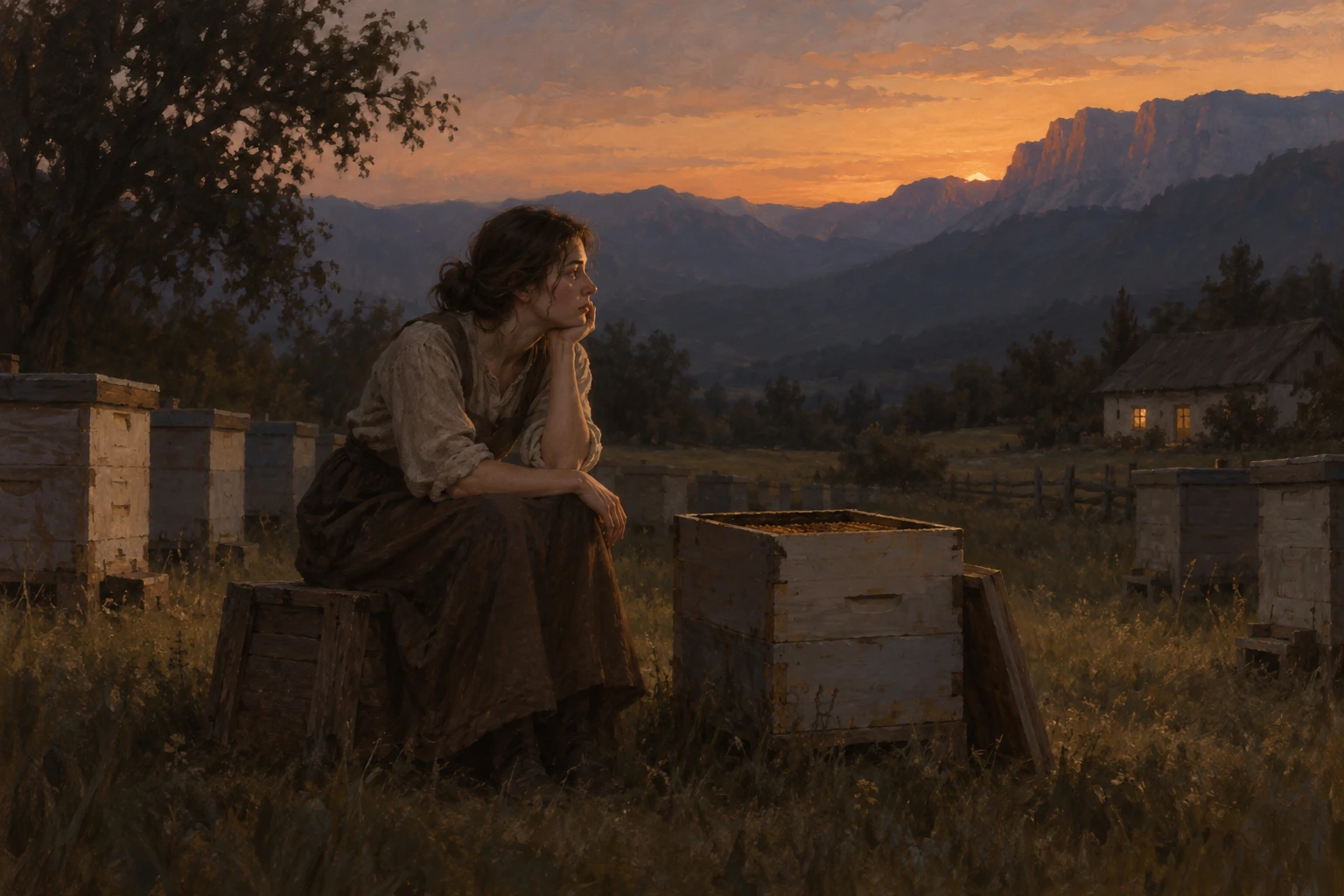
She did not go to bed. She went out instead to the bee-yard, because the day wanted settling in her before she could carry it upstairs with her, and the bees had always been where she did her settling.
It was full dusk by then, and she went down the row without any plan in her head beyond being among the hives. She found her hands, before her mind had properly caught up to them, doing the wrong season's work entirely — hefting each box a little at the back to judge its weight, the way one hefts for the winter stores and not in high summer with the last of the season's flow scarcely capped. Mouse-guards, she thought; the willow hedge wanting a cut before the frosts; and who in the valley could be trusted with two rows and three old skeps for the better part of two winters running. She found no name that satisfied her.
She stood at last at the end of the row, by the three old skeps, and did not go in. The light had gone the color of the last honey in the jar, dark and heavy, and the bees were mostly settled, and there was nothing left among them that wanted doing tonight. She stayed anyway, because staying was easier than the alternative, and because for the first time since the kitchen table three days back, no claim lay on her, and no arithmetic waited to be done, and she could, for a few minutes, simply be a girl standing in a garden who had not yet said anything to anybody.
"I don't have to," she said aloud, to the skeps, because a bee-yard at dusk was the one place she had ever said a true thing aloud without minding who heard it. "Granna offered. Granna would go, and mean it, hip and all, and nobody would think less of me for letting her." She heard how thin it sounded even as she said it — true in shape, wrong in the weight of it. She was not saying it because she believed it. She was saying it to find out whether she could.
She could not. That was what three days of counting jars wrong and laying too large a fire had been trying to tell her all along, and she let herself hear it plainly at last, standing in the blue dark with her hand on cold wood: that she was afraid, of the cold and the two years and the not-knowing what waited past the last cairn, and that being afraid of a thing had never, in all her life, been a reason her family gave for not doing it.
Dorrit found her there some minutes later, having come out ostensibly for the last of the evening's watering and in fact, Wren suspected, for exactly this. She came and stood beside her, and matched her silence for a while.
"You could say no," Dorrit said at last, without any weight laid on it. "I want you to know that's a real door and not a painted one. Granna would go in your place and never let you see what it cost her, and I would let her, because I love her enough to respect what she's asking for. Nobody in this house would think less of you."
"I know," Wren said.
"I'm not saying it to talk you into anything. I'm saying it so that whatever you decide, you decide it knowing the other one was there to be had." Dorrit hitched her shawl closer, though the evening was mild. "This part's only yours to make. Whatever's mine to decide can wait its own turn."
Wren stood with that a while, and found, under the fear, a plainer thing that had been waiting three days for her to stop being afraid long enough to notice it: that she did not, in fact, want the door Dorrit had just opened for her. She had wanted the other one since the moment the ink went dark and clear again under her own hands at that kitchen table, and had simply been too frightened, since, to call the wanting by its name.
"No," she said again, and it landed entirely differently the second time — not thin now, not testing anything, but flat and certain as her grandmother naming a jar. "I mean — no, I'm not letting her go. I'm going. I wanted to say it once, out loud, before I did anything about it, so that saying yes to the book didn't feel like the only way I ever got round to it." She let out a breath she had not noticed holding. "I'm going, Dorrit."
"Good," said Dorrit. She reached out and took Wren's hand once, briefly, and let it go. Then she went back up toward the house, giving her, with the same instinct that had sent her out to the beans the day before, the last few minutes of the yard alone.
Then she went into the house.
The kitchen was empty and one lamp was lit, low, on the table. Wren took down the tin of wax-and-tallow dressing kept for boots and for one other thing besides, and took the Waybook from its place between the clock and her great-grandfather's unsmoked pipe. And she began, with the same slow courtesy she gave a frame of comb, to oil the old leather — weeks before its season, exactly as her grandmother had done the very night the shepherd first swore he had seen green on the Gray Stair, and for the same reason.
She was still at it when she heard the stair creak, and looked up to find her grandmother standing in the doorway in her nightgown with a candle, not at all surprised to find her there.
"Oiling weather," said Granna Tansy, which was what she always said, in one form or another, of any evening that called for the tin and the cloth, and it was all she said. She went to bed by way of the table, and her hand, passing, came to rest light on Wren's left shoulder, and stayed a moment, and a moment past that, and then went on. Then she was gone up the stair, and the candle-light went with her, and the kitchen had only the one lamp again.
Wren sat a while longer with the cloth and the book, until the leather had taken all the oil it wanted and lay dark and supple, smelling of beeswax and old ink and, faintly, of mountains. Then she set the book back in its place on the shelf, between the clock and the pipe unsmoked three generations running, and blew out the lamp, and went up to her own bed, with the window left open a hand's width. And so the last thing she heard, lying there in the dark of a house that had settled around her without either of them saying a single word of what had just been decided, was the low, unbroken, ordinary murmur of the hives, steady in the dark exactly as it had been every night of her life, and, weather willing, would go on being.