The Sea Ledgers
Salt had got into the hedgerows. Wren noticed it first in the grass at her own ankles, gone shorter and wirier than the grass a week behind them, and then in the wind itself, which had stopped being a thing that simply moved and become a thing that leaned, steady from one quarter, as though the whole country had decided at last which way it wanted to face. High summer lay behind them by more than a week now, tipped past its own crown and settling toward the long gold slope of its second half, and the company walked into that slope already moving, as they had walked into most mornings that summer, the valley of the day before left behind them unspoken and unrevisited, a night's fire's distance back and staying there.
Nobody proposed talking about it. Bracken set the pace a shade quicker than usual, from the cheerfulness of a man who has smelled a change in his own trade before his eyes have caught up to it, and Dorrit walked with her chin up, testing the air as she tested a pot before deciding whether it wanted salt. The road turned coastal by inches: hedgerows gave way to low stone walls furred with a grey lichen Wren didn't know, and the walls gave way by afternoon to open turf, salt-silvered and tough underfoot.
They camped that evening on clean high ground, and Bracken built the fire without comment in the open rather than tucked into any fold — the simplest possible answer to the fire he had built the night before that wanted hiding. Dorrit fed everyone well and talked cheerfully at the wind the whole while she did it. Wren wrote a short line in the day-book before sleep, and let it stay short.
The sea came on them the second forenoon, all at once and from no particular vantage — the road simply crested a low rise the company had taken for one more of a week's worth of low rises, and there it was, filling the whole width of the world from one shoulder of land to the other.
Wren had measured the lake beyond Glaissel against every far water she knew and found it wanting nothing but a shore she could not see; she had stood on that ridge and let her inland eye fail honestly, telling herself the far bank was there, only distant, only past what any eye could carry. She tried the same trick now, out of old habit, before she understood there was no trick left to try. The lake had had a far shore, somewhere, whether she could see it or not. The sea had none to look for. It did not withhold its edge from her; it simply had no edge on that side at all, and the not-having was the whole of what she was looking at.
The wind that had leaned on them for two days did not stop here, as an inland wind does once it runs out of ground to cross; it kept going, level and steady, as though it had a very long way yet to travel and knew it. The light lay differently on the water than on anything Wren had called a lake or a river — paler, and busier, catching and losing itself in small broken pieces the whole visible distance out.
"I don't know what I expected," Dorrit said, loud enough to startle Barrow, "but it wasn't that much of it."
Pip left his sketching-board closed under his arm and said, mostly to the air, that he did not know what a person was meant to put at the top of a page that size.
Luel looked at it longer than either of them, and said at last, in a voice smaller than her naming voice, that the water had never been the Amarin's to keep. They had kept the mountain eaves, she said, and their own half of the old chain of fires, and left the sea always to people who had known what to do with that much of it. It had belonged to somebody else entirely, and she no longer knew who.
Nothing moved on the whole width of it — no sail, no smoke, no far light waiting to be explained; it lay there exactly as empty as the morning had found it, and the company stood a while longer than the halt strictly wanted, and then walked on, because the road clearly still meant to go somewhere, and the somewhere, by now, was not far.
Aveleth came on them in the early afternoon, from a low headland the road climbed and then let go of gently, down toward a harbor cut into two arms of paired stone.
"Aveleth," Luel said, before anyone else had found a word for it at all, and then, once the company had drawn close enough that the place had settled into something more than a smudge of grey roofs: "This is where the blue came from — the dye nobody east of the mountains could ever say the source of, worked by families who did their grandmothers' work and called it nothing grander than a season's living." She gave that much and no more, and let the harbor answer the rest of it.
It answered in the port's own hand rather than out of Luel's mouth: the pilings of the near quay carried a board, weathered soft but still legible, and on it, in a hand generations old and repainted at least once, the single word AVELETH — the same word Luel had given them a breath sooner.
The harbor lay still, and unmistakably asleep rather than anything worse. Small craft stood hauled above the tideline in ordered ranks, blocked square on their keels and shored with timber, tarred canvas lashed fast over the best of them; nets and gear hung stowed in open lofts above the quay, dry and dark with age but whole; sheds along the water were shuttered, their doors set square on their latches, and every mooring ring Bracken tried with his own hand held fast and true in its stone.
It was only when he came to the far end of the quay, where the water ran deep enough for a real ship to lie, that he stopped and stood a while without speaking.
The deep-water berths stood entirely empty — the one gap in an otherwise perfectly kept harbor, and, once seen, unmistakable for what it was.
"This was a sailing," Bracken said at last, flatly, "not a flight. The same hand that latched Aldern's doors and banked the mill's own wheel did every stitch of this — only here it turned the work toward the water instead of away from it. Whatever left this harbor left it the way a family leaves a house they mean to come back to and lock up soundly behind them first. The boats that could cross open water are simply the boats that aren't here any longer. Everything else stayed exactly where good sense would keep it."
The company walked the quays a while in a quiet that had nothing watchful in it. The road had sometimes asked to be minded; nothing here did. It was a sleeping harbor, and every board and rope and rusted ring of it said so.
The harbormaster's house stood at the head of the quays, squat and thick-walled against weather, its shutters swollen fast with generations of damp, and the company went in as guests go into any kept house that has not asked for them — feet wiped at the sill from long habit now, voices dropped without anyone deciding to drop them.
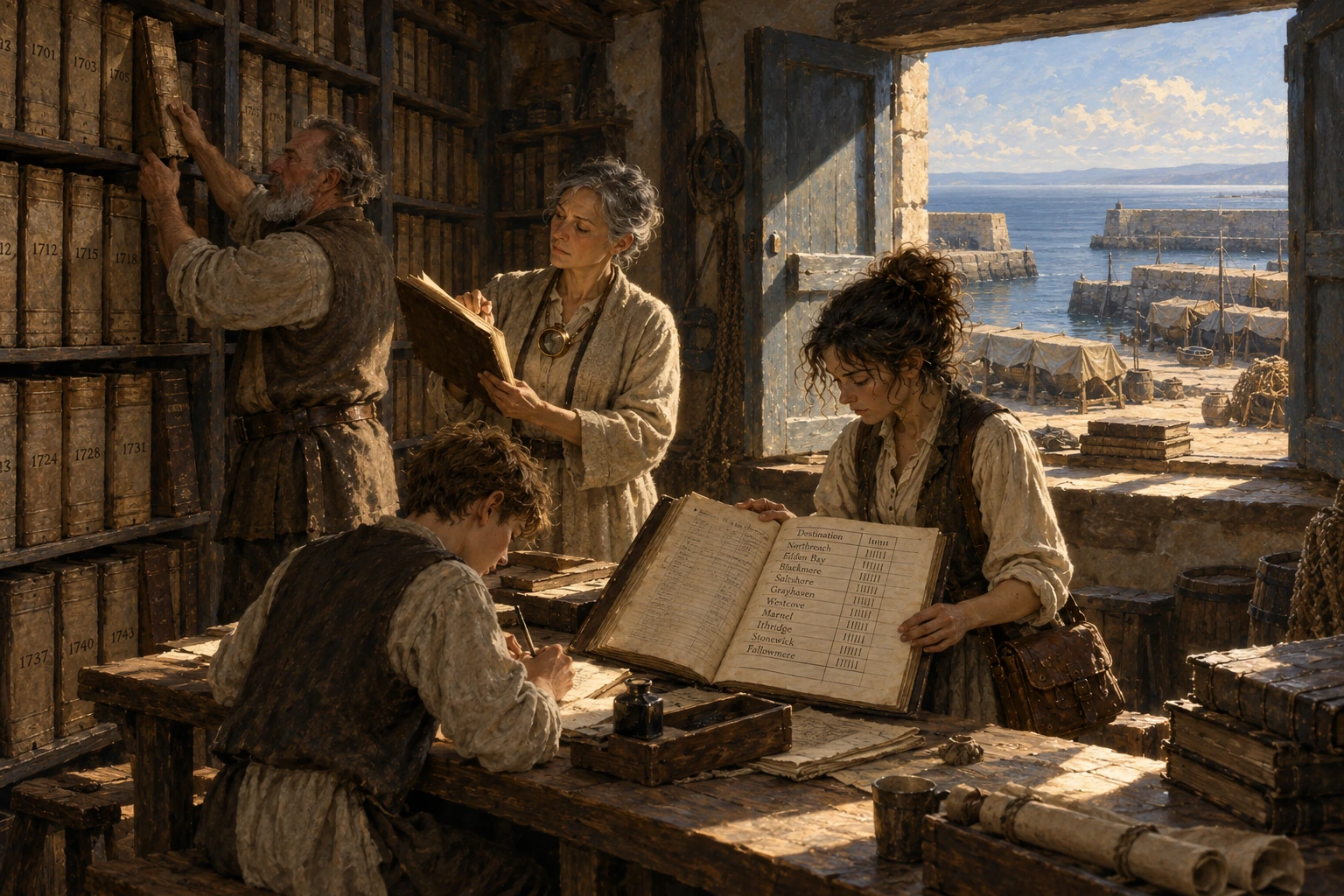
Inside was a single low counting-room, and along its inner wall, floor to rafter on bare shelves, stood the wall of books: shipping-books, ranked and dated, more of them than the room seemed built to hold and holding them anyway.
Bracken worked the shutters loose himself, one at a time, his shoulder set hard against each swollen frame until it gave with a groan and let the afternoon in; Wren stood a while looking at the shelf before she touched anything, from the quiet respect a wall of somebody else's careful years deserves before a stranger's hand goes into it.
She began at the dry end, where the room's thick walls had kept the damp off longest, and worked outward: the driest books first, the surest ground, before trusting her eye to anything the seaward wall had had generations to spoil; and the ruled columns took some minutes to learn — dates by the tide rather than the day, ships by name down the left margin, masters beside them, cargo in a wider column, dues in a narrower one.
And under all of it, the bulk of the thing was gloriously ordinary. Sailings and arrivals by the tide. Ships by name — Fair Wind, Grey Petrel, and one square and sure in a clerk's steady hand, Kestrel Down. Masters named as simply as their ships: Duncan Colvane, Aun Havard, Tobin Havard a generation later, the name Havard recurring page after page across the better part of a century, as a family name recurs in any working town where the same trade is handed on, unremarked, from a mother's hand to a daughter's. Cargo in and cargo out. Harbor dues paid and logged. Years and years of it, dense and dull and entirely, restfully safe.
"It's the ink that gets me," Iyene said quietly, turning a page with the flat of one finger. "Woldsend's book never faded at all in three hundred years, and that unfading was the Quiet's own hand on it. This is ordinary ink. Ordinary damage." She held the page a moment to the window's new light. Where the room had stayed dry the writing sat brown but perfectly legible; nearer the seaward wall the pages ran foxed and part-eaten by damp long since dried again, whole names gone under a stain with nothing left to guess them by. "There," she said of one such gap, and did not try to fill it. "That one's gone. The book itself has forgotten them. I'd rather say so than guess at it."
The turn came in the last volume's later pages, and Wren found it herself, the dry books read first exactly as they should have been, working forward at last into the one shelf whose spine told her it was the youngest.
For most of its length that final book read no differently than any of the others — tides, ships, masters, cargo, ordinary years laid down in an ordinary hand. And then, a good way in, the cargo column began to carry a different freight. Household goods, the entries read, where they had once read wool and dye and glass. Seed grain. Tools. Looms. And beside the freight, in a new narrow column the clerk had ruled fresh for the purpose, a tally began to appear: not crates, not weight, but souls — a household's worth of them, counted out beside their goods the same dry, careful way the tide-book counted a fair wind or a foul one.
The first sailing to carry the full weight of it was entered whole, in the same steady hand as everything around it, dry clerk's language and nothing more:
Passage taken west-over-sea in the ship Kestrel Down*, master Tobin Havard; household of six aboard, with such goods as could be carried and no more; stated intent, entered at their own asking and in their own words: to return when the road home is lit again.*
Wren read it through twice before she let herself go on, and then read on, and found the same intent entered again three sailings later, in full a second time, and again a fourth — not once, as a single grand farewell might have been entered, but sailing after sailing, each household given the whole sentence afresh, as though the clerk had understood, better than any single mourner could have, that a promise said only once is a promise easily mistaken for ceremony, and a promise repeated, faithfully, every single time it was owed, is something else again.
Then, as the sailings began to come thicker down the page, the clause began, gradually, to shorten. Household of four aboard the Fair Wind*, master Duncan Colvane; stated intent as above.* A few entries later: As before. And then, for page after page after that, nothing but a single stroke set beside each sailing where the clause had stood — a small repeated mark, the clerk's own shorthand for a sentence too often written to keep writing whole.
Wren sat a long while over that column of marks before she understood what she was actually reading. Each stroke was not an absence. Each stroke was the whole sentence, said again — to return when the road home is lit again, entered as fully, in the clerk's own understanding, as the first time it had ever been spelled out in full. A column of small identical marks, and every one of them a promise repeated once more, for one more household, by a hand that had evidently never grown tired enough of the promise to stop entering it, only tired enough of the words to stop spelling them out.
It asked, in its own quiet clerk's way, to be understood rather than wept over, and she set it down carefully in her own mind for the day-book.
The very last sailing stood in the same hand as the first, no different in weight, no different in care: a household of three, the ship Marigold, master Joss Bidwell. Beneath it, the clerk had ruled the next line, exactly as every line before it had been ruled, and left it. Nothing was written on it. It was not a vow. It was not addressed to anyone who might come after. It was, as near as Wren could read it, simply a person who had expected, in the most ordinary way, to write again — and the ruling of that one empty line said the whole of what there was to say about a person who never got to.
The clerk was never named anywhere in three volumes of dense, careful years, and Wren did not go looking for a name that clearly had never wanted giving.
"I won't total it," Iyene said, some while later, closing the last volume with both hands flat on its cover before she let it rest. "I could count you a page of households easily enough, but I won't set a figure to the whole of it, and I'll say why. The seaward pages of the earlier books are part lost — foxed clean through, in places, with no way of knowing how many sailings went under that damp before anyone here ever thought to guard against it. And this last page isn't the last sailing either, not truly — only the last one anybody lived to write down. A total wants two firm ends to stand between. I haven't got either one. It stays open, and it stays honest, and those are worth more to me together than a tidy wrong number would be alone."
The destination appeared nowhere as a story and everywhere as a place-name, entered bare in its own column as a clerk enters a word he has written a thousand times and has never had to explain to anyone: Velmar.
"It's a real word," Luel said, when Wren asked, "in the old tongue, before the common speech had its own way of carrying it. As near as your own words will hold it: the far shore." She let that stand a moment. "It is a direction with a name on it, and that is as much as anyone ever truly had of it, even before the closing. How far, or what waits there, or whether a single soul that left this harbor ever set foot on any shore at all — I cannot tell you, and will not guess at telling you. My people were never sailors. I never went. I only know the word, and what it means, and that it is the truth as far as it goes and no further."
Nobody proposed following the word west to find out what it might answer for. The thought, if it crossed any mind in that room, crossed it and was set down again.
They carried the working talk out onto the quay, once the last volume was closed, standing in ordinary afternoon light with the empty harbor for a floor.
"Three times now," Iyene said, counting on her own fingers, "the Survey has come west asking what became of Meddan's people, and three times the west has answered on the actual ground under our feet. Down, at Stanhope. Stayed, at Woldsend, and again in the valley we left two mornings back. And now out, over the water, from here."
Alder, who had said almost nothing all day, spoke then. "There was a fourth movement, and it was never truly a mystery to anyone, only to us, coming at it from the wrong side of it. Some went east, over the passes, while the passes still stood open — and the east has known that answer since the closing itself, because the east is where they arrived." He let the count Iyene had just spoken stand exactly as she had spoken it. "The number on the page stays at three. This is only the quiet footnote underneath it."
Dorrit was the one who said the plain thing, as she generally was. "Those ships are sitting somewhere, waiting on a lit road," she said, "and there's a lit road going in behind us this very summer, hill by hill, whether anybody out there knows it or not."
"Nobody knows that anyone is left to watch for it," Iyene said at once, and gently. "I won't write down that they do. I'll write down what the ledgers say, and what the fires say, and let the two of them sit beside each other as they are, without pretending they've shaken hands."
"The condition those people named is being met," Alder said, once. "Not for them — we never knew, until this year, that there was anything of theirs left to do it for. And not by us alone. But it is being met, this summer, on this road, and it was not being met a year ago."
Aveleth went down in both books with the same plain marking Iyene had been setting beside sleeping towns since the province gate, and the answer she wrote out in words instead, twice over, once in each book. "The valley had nothing in it a stranger could read," she said. "This was written down to be read by a stranger. The least a stranger can do is read it, and copy it, and carry it somewhere it can be read again."
Iyene and Pip took the trestle in the counting-room's best light for the whole of the afternoon, copying out the outbound sailings in full — ships, masters, households, cargo, the standing clause given whole wherever it had been given whole, the column of marks rendered faithfully as marks — while Wren found the volumes and held them open at the right pages. Iyene added no word of her own beyond what the ledger held. "I'm recording an intent," she said once, without looking up. "Not an outcome. The two are not the same animal, and I won't let my own hand blur them." The books themselves she left where they stood. She allowed herself one observation, that a harbor this whole and untouched was exactly the sort of thing a salvage claim would love on sight, and that her copy would go east on the first post that could carry it, and left the matter there.
Dorrit had found her own corner of the afternoon in the harbormaster's overgrown dooryard — a scrap of kitchen-garden gone feral, and among the bramble and the salt-burnt weeds one low grey-leaved thing still stubbornly growing. She crouched over it and put her thumb to a leaf and said, "Sea-holly," pleased; and then, in exactly the same voice and without any pause at all, "balm," and stopped.
She sat back on her heels.
"It's back," she said. "Just now. Sitting there as though it had never gone anywhere."
She made nothing of it, and left the plant where it stood, and went in to see whether the copying wanted a third pair of hands. Wren, who had been counting the days without ever deciding to, made it better than a fortnight.
"Read me one," Luel said, toward the end of the afternoon, when the copying had nearly caught the last of the light. "Not the promise. An ordinary one."
Wren found a page well back from the turn, a year like any other on either side of it, and read it aloud, evenly, as the clerk himself might once have read it to check his own hand: the Fair Wind, master Duncan Colvane, household of four, sailed on the evening tide, cargo wool and salt fish, dues paid in full.
It was, Wren thought, the first time since the closing that any of those names had been said aloud in that room, by any mouth at all.
Luel sat with it a while after Wren had finished. "They had time to write it down," she said at last, quietly. "I did not know, until this afternoon, that they had had time to write anything down at all." She did not say they would come back. She did not promise anything, and did not grieve on the page, and was, when she rose again, exactly as whole as she had been when she sat.
Bracken drew the harbormaster's door to behind the last of them as they left, and dropped its latch.
They walked out along the seaward quay at evening, the last built thing before the water, the light going long and gold across stone that had stood sound and waiting since the closing for exactly nobody, until this one.
Pip began it without anyone noticing him begin — a tune worked loose under his breath as he walked, until it was not under his breath at all but simply singing, clear and full and entirely unembarrassed: the voice Maren at the Steading Lamp had once said oughtn't to be kept for washing dishes to, put at last to the use it had always been waiting for.
The others came in by the second stanza, raggedly, in whatever voices the evening found them with — Dorrit half a beat behind the tune and enjoying herself thoroughly for it, Bracken low and steady, Iyene surprising herself with how much of it she still had by heart; Luel came in with them, one voice among seven, not leading and not carried above the rest.
It burned a long time, burning alone— so the old song told it, plain and true; but the road came west to Wakelow's stone and found one fire still burning through.
The second and third stanzas went by sung and unprinted, and in the third Kelder's name went out over the water with the rest — a hill still waiting, west and dark, that the company had not yet reached.
So sing it walking, sing it home, in whatever voice the road provides— a fire that kept its watch alone now keeps its watch with company beside.
It carried out over empty stone and empty water, the harbor's whole audience nothing but the mole-heads and the tide, and nothing answered from the sea at all — no light, no echo, no shape on the water where none had been all day. Nobody had expected one, and nobody minded: nothing was wasted on the empty air, any more than a lamp left burning for a sleeping house is wasted on a room that cannot yet thank it.
Wren took the Waybook out alone that evening, once the fire was going and the others had settled to their own quiet ends of it, and turned to the page she had half-expected all afternoon.
Wystan's Aveleth sat drawn spare on the vellum, the harbor's paired moles rendered in the same patient grey as every road and water he had ever set down, a margin figure beside it — a small "5," his own habit for days walked since his last fixed point — and, beneath the figure, one line only, in his spikier hand, in the common speech: the first western margin Wren had ever found written in words she did not have to guess at.
Quays sound. Ships still sailing. They mean to come back.
Ten words, set down as a man sets down a ford's depth or a spring gone bad — reported, not felt; walked, not wished. Wren held her two fingers beside the ink a long while, never on it.
She gave Iyene the bare fact of it later, in one flat sentence by the fire — that Wystan had passed through Aveleth once, and the port had still been working when he did — and kept the rest of the weight of it for herself, and for the page.
The town is called Aveleth, Wren wrote, with the fire down to its red and the tide working somewhere below her in the dark, and its ledgers hold more names than any of us could count in an afternoon — ships, and masters, and households sailed out west-over-sea, every one of them carrying the same stated intent, entered in full the first time and worn, sailing by sailing, down to a single small mark repeated the length of a page. I read that column for the better part of an hour before I understood that every mark was the whole sentence, said again. The last page ends in the same steady hand as the first, and then a ruled line, empty, waiting on a hand that never came back to fill it.
Wystan's own margin agrees with those books across all the years between, in ten bare words that never tried to be more than what a man sees passing through a working port. Land and sea, telling the same true thing twice, in two different keys, and neither of them aware the other had spoken at all.
I keep thinking of Maren at the Steading Lamp, who told me once that you keep the filled books, because someone always comes wanting a name. And of Edda at Sereth, who kept the empty one instead, and trusted the road to fill it in its own good time. Aveleth kept the filled ones too, exactly as Maren would have kept them — and nobody ever came, for three hundred years, until this afternoon, when somebody did, wanting a name, and got several hundred of them for the asking.
Every name in that room has been sitting three hundred years in a shut book, in a dry corner, in a good hand, waiting for somebody to come and want it — and today somebody came.